Ayutthaya Day Trip from Bangkok — Guided Temple Tour with Lunch (2026)
Ayutthaya served as the capital of Siam for over 400 years and today stands as one of Southeast Asia's most significant archaeological sites, with ruined temples, decapitated Buddha statues and riverside chedis spread across an island ringed by three rivers. This guided day tours from bangkok thailand covers the main temple complexes in a single 9-hour round trip from the city, with lunch included. The tour is rated 4.7 stars from 4,213 travelers — here is everything you need to know before you book.
About This Activity
Cancel up to 24 hours before — full refund
Secure your spot today with no upfront payment
Depart Bangkok at 07:30, return approximately 18:30
Thai lunch served at a local restaurant during the tour
Ayutthaya Historical Park — inscribed 1991
One of the highest-rated Bangkok day trips on GetYourGuide
Check Live Availability & Prices
Real-time departure dates and pricing — free cancellation up to 24 hours before departure.
Ayutthaya UNESCO Heritage — What You'll See
Ayutthaya was founded in 1351 and grew to become one of the largest cities in the world by the 17th century, with a population estimated at one million people and diplomatic relations with France, the Netherlands, Portugal, Japan and Persia. In 1767 the Burmese army sacked and burned the city, leaving behind a landscape of ruined temples, headless Buddha statues and collapsed tower spires that has remained largely untouched for over 250 years.
The Ayutthaya Historical Park was inscribed as a UNESCO World Heritage Site in 1991 and covers an area of approximately 289 square kilometres on an island formed by the confluence of the Chao Phraya, Pa Sak and Lopburi rivers. The park contains more than 400 temples, palaces and statues dating from the 14th to 18th centuries — the guided tour focuses on the most historically significant and visually striking of these sites.
Key facts about Ayutthaya's historical significance:
- Capital of the Kingdom of Siam from 1351 to 1767 — 33 kings across 5 dynasties
- At its peak, one of the world's largest cities by population
- Destroyed by Burmese forces in 1767 — the ruins have remained since
- UNESCO World Heritage Site since 1991 — Ayutthaya Historical Park
- Located approximately 80 kilometres north of Bangkok — about 1.5 hours by road
- Contains more than 400 temples, palaces and historic structures within the park
The Main Temples Covered on This Tour
Wat Phra Si Sanphet
Wat Phra Si Sanphet was the grandest temple within the royal palace compound and the spiritual centre of the Ayutthaya kingdom. Built in the 15th century, it served as the royal chapel and housed a 16-metre standing Buddha covered in 250 kilograms of gold — melted down by Burmese invaders in 1767. What remains today are three iconic Ceylonese-style chedis (bell-shaped stupas) in a row, built to contain the ashes of three Ayutthayan kings.
These chedis are the most photographed structures in Ayutthaya and the defining image of the UNESCO site. The surrounding grounds contain the remains of the royal palace complex, though the palace itself no longer stands above foundation level.
Wat Mahathat
Wat Mahathat is one of the oldest and most important temples in Ayutthaya, dating from the late 14th century. The temple was the seat of the Supreme Patriarch of Thai Buddhism during the Ayutthaya period. The central prang (Khmer-style tower) collapsed centuries ago, but the ruins of the surrounding cloisters, chapels and smaller chedis cover a large area.
Wat Mahathat is most famous for a single image: a stone Buddha head entwined within the roots of a Bodhi tree. The roots have grown around the head over several centuries, holding it gently at ground level. Photography at this tree requires respectful positioning — visitors must kneel or sit at the same level as the Buddha image, not stand above it.
Wat Ratchaburana
Wat Ratchaburana stands directly opposite Wat Mahathat and was built in 1424 by King Boromrachathirat II on the cremation site of his two brothers, who died fighting each other for the throne on elephant-back. The temple's main feature is a well-preserved Khmer-style prang with interior crypt chambers still partially intact. A significant cache of royal treasures — including golden figurines, jewellery and Buddha images — was discovered in the crypt during the 20th century and is now held in the Chao Sam Phraya National Museum in Ayutthaya.
The scale of the central prang gives a clear impression of what the tallest towers of ancient Ayutthaya originally looked like before the Burmese destruction.
Wat Chai Watthanaram
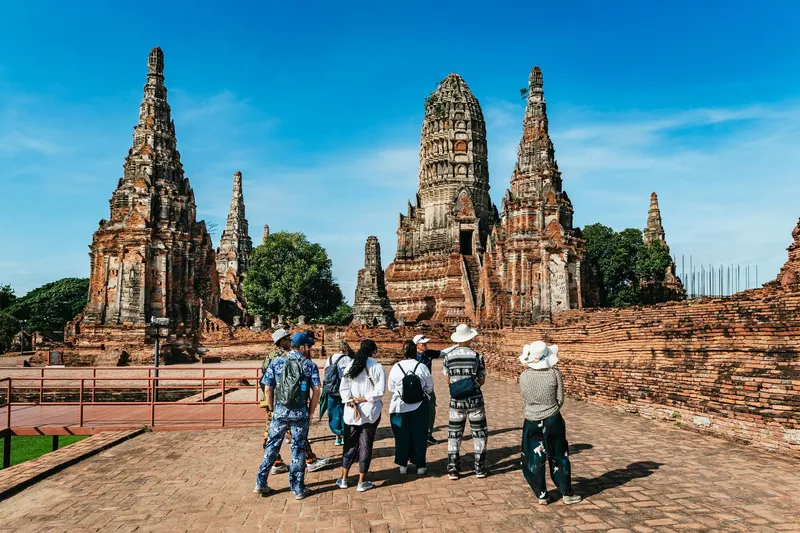
Wat Chai Watthanaram sits on the western bank of the Chao Phraya River outside the main island and was built by King Prasat Thong in 1630 to commemorate a military victory over Cambodia. The temple's design is directly influenced by Angkor Wat — a central Khmer-style prang surrounded by four corner towers and galleries of headless Buddha statues, all built to represent Mount Meru, the cosmological centre of the universe in Buddhist and Hindu belief. The riverside setting makes Wat Chai Watthanaram one of the most atmospheric ruins in Ayutthaya, particularly in the late afternoon when the sun falls across the brick towers from the west.
This is the last major temple visited on most day tours from Bangkok.
9-Hour Ayutthaya Day Trip Itinerary — Depart 07:30, Return ~18:30
-
07:30
Depart Bangkok
Pickup from Bangkok hotel or central meeting point. Air-conditioned minivan or coach north along Highway 1 toward Ayutthaya — approximately 1.5 hours depending on traffic. Guide provides historical background on the Ayutthaya kingdom during the journey.
-
09:00
Arrive Ayutthaya Historical Park
Enter the UNESCO Historical Park. First stop: Wat Phra Si Sanphet — the royal temple with three iconic chedis and the ruins of the royal palace compound. Guide covers the history of the Ayutthaya kings and the Burmese destruction of 1767.
-
09:45
Wat Mahathat and the Buddha tree root
Walk to Wat Mahathat, one of Ayutthaya's oldest temples. Visit the famous sandstone Buddha head entwined within Bodhi tree roots — guide explains the protocols for photographing the image respectfully. Explore the surrounding ruins of the central prang and cloisters.
-
10:30
Wat Ratchaburana
Cross to Wat Ratchaburana — the 15th-century temple with a Khmer-style prang built on a royal cremation site. The guide explains the story of the two rival princes and the treasures discovered in the crypt.
-
11:15
Free time in the historical park
Short free exploration period in the central park area. Optional: visit nearby elephants or explore independent areas of the ruins not covered in the guided route.
-
12:00
Lunch at a local restaurant
Thai lunch at a local restaurant near the historical park — included in the tour price. Typically a set menu with rice dishes, soup and fresh fruit. Vegetarian options are usually available; inform the operator at booking if required.
-
13:15
Wat Chai Watthanaram
Drive to the western bank of the Chao Phraya River and the Angkor-influenced Wat Chai Watthanaram. Explore the gallery of headless Buddha statues and the central prang complex. Afternoon light from the west creates the best photography conditions here.
-
14:30
Optional: Ayutthaya National Museum or river view
Depending on the specific tour variant, this slot covers either the Chao Sam Phraya National Museum (holding treasures excavated from Wat Ratchaburana) or a riverside rest stop with views of the Chao Phraya and the temple skyline.
-
15:30
Depart Ayutthaya for Bangkok
Board the minivan or coach for the return drive to Bangkok. Traffic on the return journey (particularly around 16:00–18:00) can extend the return time.
-
18:30
Arrive back in Bangkok
Drop-off at Bangkok hotel or central departure point. Return time is approximate — budget up to 19:30 during heavy traffic periods.
Important Things to Know
What to Bring
Ayutthaya is an exposed archaeological site with limited shade. Most temple ruins are open stone or brick structures without roof cover, and the ground is uneven throughout. Preparation matters:
- Sunscreen — high SPF essential; reapply between temples as there is little shade
- Hat or cap — wide-brim preferred for the open ruin areas
- Comfortable, closed-toe walking shoes — uneven brick and stone surfaces throughout; sandals are not recommended
- Light clothing covering shoulders and knees — required at all temple sites; sarongs are sometimes available for hire at temple entrances but bringing your own is more comfortable
- Water bottle — refillable; drink frequently in the heat
- Camera or phone — photography is excellent throughout the site, especially at Wat Chai Watthanaram in afternoon light
Not Allowed
Ayutthaya Historical Park is a UNESCO-protected site with specific rules that are actively enforced:
- Climbing on temple ruins — strictly prohibited throughout the park; fines apply and the stones are genuinely unstable in places
- Touching or sitting on Buddha statues — disrespectful and prohibited under Thai law; this applies to the famous tree-root Buddha head at Wat Mahathat
- Drones without a permit — UAV flight over the UNESCO site requires advance permits from the Fine Arts Department; tourist drones are not permitted
- Littering — Ayutthaya Historical Park has active conservation teams; fines apply
Heat and Physical Demands
Ayutthaya is typically 33–38°C between March and June, with high humidity. The guided route covers several kilometres of walking across open ground between temple sites, often with no shade. The heat in central Thailand is intense by mid-morning even in cooler months.
Pace yourself between temples, drink water consistently rather than waiting until thirsty, and use any available shade during rest periods. Guides on well-reviewed tours are experienced with managing group energy in the heat — follow their recommendations on timing and rest stops.
Who This Tour Is For
Best For
- History and archaeology travellers wanting the most important Ayutthaya temples covered in a single day from Bangkok
- First-time visitors to Thailand for whom Ayutthaya is a bucket-list UNESCO destination
- Travellers who want guided context on the ruins rather than independent exploration without background
- Those who prefer a structured itinerary with transport, guide and lunch organised in advance
- Photographers seeking the Wat Mahathat tree root, the Wat Phra Si Sanphet chedis and Wat Chai Watthanaram at golden hour
Not Suitable For
- Not suitable for those unable to walk for extended periods in heat — the tour covers several kilometres on foot over uneven ancient ruins
- Not suitable for wheelchair users — ground surfaces throughout the historical park are rough, uneven and often unpaved
- Not recommended for children under 6 — the walking distances, heat exposure and pace make the full day tour physically demanding for very young children
Ayutthaya Day Trip from Bangkok — FAQs
How far is Ayutthaya from Bangkok and how long does the drive take?
Ayutthaya is approximately 80 kilometres north of central Bangkok. By road the drive takes around 1.5 hours in normal conditions, departing early morning before traffic builds. On the return journey in the late afternoon, traffic around Bangkok can extend the drive to 2 hours or more. The tour departs at 07:30 specifically to minimise outbound traffic time.
What temples are included in the tour?
The tour covers the four most significant temple complexes in Ayutthaya Historical Park: Wat Phra Si Sanphet (the royal temple with three chedis), Wat Mahathat (famous for the tree-entwined Buddha head), Wat Ratchaburana (15th-century Khmer prang with royal history), and Wat Chai Watthanaram (riverside Angkor-influenced temple built in 1630). Some tour variants also include brief stops at additional sites within the park depending on the operator's current itinerary.
Is lunch really included and are there vegetarian options?
Yes — lunch at a local Thai restaurant is included in the $40 tour price. The meal is typically a set menu with rice dishes, soup and fruit. Vegetarian options are usually available but should be requested when booking, not assumed. The guide will confirm dietary requirements before the restaurant stop.
What should I wear to enter the Ayutthaya temples?
All active temple sites require covered shoulders and knees. Light cotton or linen trousers and a T-shirt with sleeves are the practical choice — they meet the dress code and keep you cooler than heavier fabrics. Avoid sleeveless tops and shorts above the knee. Sarongs are sometimes available at temple entrances for hire, but bringing your own clothing is more comfortable given the walking distances.
Are there more day trips available from Bangkok?
Yes — Ayutthaya is one of the most popular full-day excursions from the city, but there are guided day tours to floating markets, national parks, river delta communities and other historical sites. See the full range of bangkok thailand tours to find the right option for your trip.
What Travelers Say About the Ayutthaya Day Trip
The guide was genuinely knowledgeable about Thai history — not just reciting dates but explaining the context of why Ayutthaya mattered and what was lost in 1767. The tree-root Buddha at Wat Mahathat was extraordinary in person. Lunch was better than expected. We were back in Bangkok by 18:30 as promised. Would book this tour again on a return visit.
I was nervous about the heat but our guide managed the pace well — we were at the exposed sites in the morning and moved to lunch during the hottest part of the day, then Wat Chai Watthanaram in the late afternoon when it's actually beautiful. Smart scheduling. Bring more sunscreen than you think you need.
Wat Chai Watthanaram at the end of the day was the highlight for me — the light was incredible on the brick towers and there were almost no crowds by that point. The history context from the guide throughout the day made every ruin meaningful rather than just a pile of old bricks. Very well-run tour.