Bangkok: Ayutthaya UNESCO Heritage Experience with Boat Ride — Full Guide (2026)
Ayutthaya's ruined temples rise from the flat riverine plain with a drama that is best understood from the water. This tour gives you exactly that: a boat ride along the Chao Phraya River as part of the journey to the ancient capital, so your first view of the UNESCO World Heritage Site is the one that travellers from the 17th century would have recognised — spires and chedis emerging from the river bend, the landscape of a kingdom that once commanded all of mainland Southeast Asia. For those planning bangkok thailand tours that go beyond the city, this is the most immersive way to experience Ayutthaya in a single day.
About This Activity
River cruise on the Chao Phraya or Pa Sak River — see Ayutthaya from the water
Cancel up to 24 hours before — full refund, no questions asked
Depart Bangkok at 07:30, return approximately 18:30–19:00
Ayutthaya Historical Park — inscribed 1991; 400+ temples, palaces and monuments
Secure your spot with no upfront payment required
One of the highest-rated Ayutthaya tours on GetYourGuide
Check Live Availability & Prices
Real-time departure dates and boat ride tour pricing — free cancellation up to 24 hours before departure.
Ayutthaya UNESCO Heritage — What You're Visiting
Ayutthaya served as the capital of the Kingdom of Siam for over 400 years, from its founding in 1351 until its destruction by Burmese forces in 1767. At its height in the 17th century, the city had a population exceeding one million people and maintained diplomatic relations with France, the Netherlands, Portugal, Japan and Persia — it was one of the most cosmopolitan trading cities in the world.
The Burmese invasion of 1767 left the city in ruins. The temples, palaces and tower spires were burned, looted and largely abandoned. What remains is now the Ayutthaya Historical Park — a UNESCO World Heritage Site since 1991, covering approximately 289 square kilometres on an island formed by the Chao Phraya, Pa Sak and Lopburi rivers.
Key facts about Ayutthaya's significance:
- Capital of the Kingdom of Siam from 1351 to 1767 — 33 kings across 5 dynasties
- At its peak, one of the world's most populous and commercially active cities
- Sacked by Burmese forces in 1767 — ruins have remained largely untouched since
- UNESCO World Heritage Site since 1991 — Ayutthaya Historical Park
- Situated approximately 80 kilometres north of Bangkok, on a river island
- Contains more than 400 temples, palaces and historic structures
The Boat Ride — What You See from the River
The boat component of this tour is what separates it from a standard bus-only Ayutthaya day trip. Rather than arriving entirely by road, part of the journey — either the approach to Ayutthaya, the return to Bangkok, or a dedicated river segment within the historical park — takes place by boat on the Chao Phraya River or the Pa Sak River that borders Ayutthaya island.
The river approach to Ayutthaya is one of the most atmospheric ways to understand the city's geography. Ayutthaya sits on a man-made island ringed by three rivers, and arriving by water gives an immediate sense of why this location was chosen as a capital: easily defensible, at the meeting of major river trading routes, visible for miles in every direction. The temple spires and brick chedis that rise above the flat riverside plain are the same sight that ambassadors, merchants and pilgrims would have seen from boats during the city's 400-year reign.
- The profile of Wat Chai Watthanaram seen from the Chao Phraya — its Khmer-style towers are best appreciated from water level
- The riverside embankment of the historical park, with temples visible through riverside vegetation
- The confluence point where the Chao Phraya and Pa Sak rivers meet at the southern tip of Ayutthaya island
- Traditional wooden rice barges and working river vessels that still operate on the same waterways
- The changing skyline of temple ruins as the boat rounds the river bend into the historical park area
Why the River Route Matters Historically
For most of Ayutthaya's 400-year existence, the river was the primary approach to the city. All significant trade, diplomacy and military movement entered Ayutthaya by boat. The Dutch, Portuguese and French trading posts of the 17th century were established along the riverbanks, and the royal palace complex faced the water.
Arriving by river reconnects this tour with the city's actual historical logic in a way that no road transfer can replicate.
Temples Visited on This Tour
Wat Phra Si Sanphet
The grandest temple within the royal palace compound and the spiritual centre of the Ayutthaya kingdom. Built in the 15th century, it housed a 16-metre standing Buddha covered in 250 kilograms of gold before the Burmese destruction. Today the defining feature is three iconic Ceylonese-style chedis in a line, built to contain the ashes of Ayutthayan kings.
These chedis are the most photographed structures in the historical park and one of the defining images of ancient Thailand.
Wat Mahathat
One of the oldest and most important temples in Ayutthaya, dating from the late 14th century, and the seat of the Supreme Patriarch of Thai Buddhism during the Ayutthaya period. The temple is most famous for a stone Buddha head entwined within the roots of a Bodhi tree — the roots have grown around the head over several centuries, creating one of the most powerful images in all of Southeast Asian archaeology. Visitors are required to photograph this image from a respectful kneeling position at ground level.
Wat Ratchaburana
Built in 1424 by King Boromrachathirat II on the cremation site of his two brothers, who died fighting each other for the throne in single combat on elephant-back. The temple's Khmer-style prang is well preserved, and crypt chambers beneath it yielded a significant cache of royal treasures — golden figurines, jewellery and Buddha images — now held in the Chao Sam Phraya National Museum. The prang gives a clear sense of what Ayutthaya's towers looked like before the 1767 destruction.
Wat Chai Watthanaram
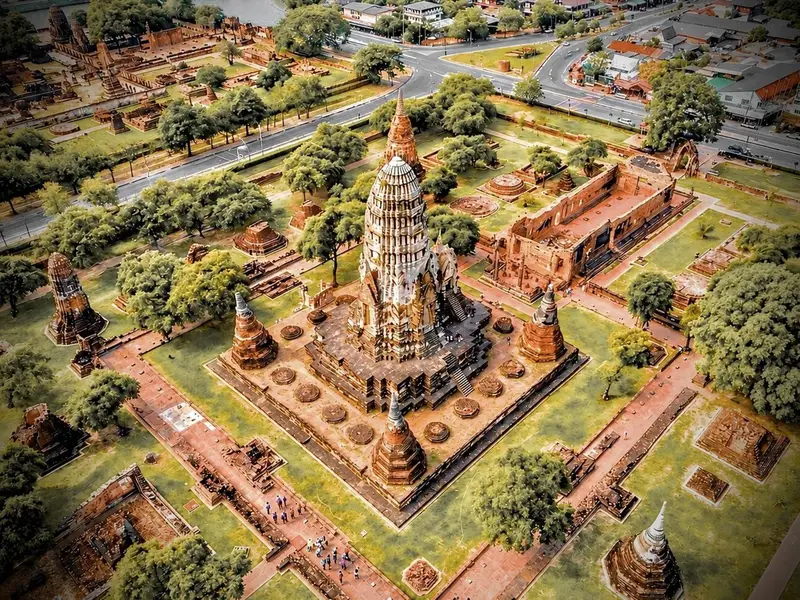
Built in 1630 on the western bank of the Chao Phraya River, directly influenced by the design of Angkor Wat — a central Khmer prang surrounded by corner towers and galleries of headless Buddha statues, all representing Mount Meru. The riverside setting makes this one of the most atmospheric sites in Ayutthaya. Arriving by boat, the silhouette of Wat Chai Watthanaram's towers against the river sky is the visual highlight of the entire experience.
How This Tour Differs from a Standard Ayutthaya Day Trip
There is already a well-reviewed Ayutthaya day trip available from Bangkok at a lower price point — 9 hours, by road both ways, covering the same core temples. The question is whether the boat ride component justifies the difference, and the answer depends on what kind of traveller you are.
The standard road-only tour is efficient: you arrive by minivan, cover the main temple circuit with a guide, eat lunch and return. The temples are the same. The guide quality is comparable. For travellers whose priority is seeing the ruins without spending extra, that tour does the job.
This 10-hour boat tour adds a fundamentally different layer:
- River arrival or departure gives Ayutthaya's island geography a physical reality that road arrival obscures
- Wat Chai Watthanaram is best seen from the water — its riverside position was designed for river viewing, not road viewing
- The extra hour in the 10-hour itinerary typically allows for a slower pace between temples — less rushed than the 9-hour variant
- The boat segment itself is a genuine experience, not just a transfer — you are on the same river that defined this city's entire existence
- For photography, river-level shots of temple ruins framed by the Chao Phraya are not achievable on a road-only tour
Who Should Choose This Tour Over the Standard Option
Choose this boat tour if the river journey itself matters to you — if you want to understand Ayutthaya as a river city rather than just visiting its ruins. Choose the standard day trip if your priority is maximum efficiency and covering the temples at the lowest cost. Both tours are excellent; the boat tour is simply a richer, slower, more atmospheric version of the same destination.
10-Hour Ayutthaya Boat Tour Itinerary — Depart 07:30, Return ~18:30
-
07:30
Depart Bangkok by air-conditioned vehicle
Pickup from Bangkok hotel or central meeting point. The journey north toward Ayutthaya takes approximately 1.5 hours by road. Your guide provides historical context on the Ayutthaya kingdom, the Burmese wars and the significance of the river system during the transfer.
-
09:00
Board the river boat
At the embarkation point on the Chao Phraya River or Pa Sak River, board the tour boat for the river approach to Ayutthaya. This is your first view of the ancient city from the water — temple spires and brick chedis visible above the riverside vegetation. The guide explains the historical importance of the river routes to the kingdom's trade and defence.
-
09:30
River passage along Ayutthaya's perimeter
The boat travels along the river boundary of Ayutthaya island, passing the exterior of Wat Chai Watthanaram and other riverside ruins. This river-level perspective of the temples is the visual centrepiece of the tour — and the one that no road-only Ayutthaya day trip can replicate. Photography conditions in the morning light are excellent from the boat.
-
10:00
Disembark and enter the UNESCO Historical Park
Step ashore and enter the Ayutthaya Historical Park. First stop: Wat Phra Si Sanphet, the former royal temple with its three iconic chedis containing the ashes of Ayutthayan kings. Your guide covers the layout of the original palace compound and the scale of what the Burmese destroyed in 1767.
-
10:45
Wat Mahathat — the tree-root Buddha
Walk to Wat Mahathat, one of Ayutthaya's oldest temples. Visit the sandstone Buddha head entwined in Bodhi tree roots — the guide explains the protocols for photographing this image respectfully (kneeling at ground level, never standing above). Explore the surrounding ruins of the collapsed central prang and cloisters.
-
11:30
Wat Ratchaburana
Proceed to Wat Ratchaburana, the 15th-century temple built on the site of a royal duel between two princes. The well-preserved Khmer prang gives a strong impression of the original scale of Ayutthaya's towers. The guide recounts the story of the royal treasures discovered in the crypt and their transfer to the national museum.
-
12:15
Lunch break
Lunch at a local restaurant near the historical park. The meal is typically a Thai set menu — rice dishes, soup and fruit. If you have dietary requirements, inform the operator at the time of booking; the guide will confirm arrangements before the restaurant stop.
-
13:30
Wat Chai Watthanaram — the riverside Angkor
Drive to the western bank of the Chao Phraya for Wat Chai Watthanaram — the Angkor Wat-influenced temple built in 1630 with a central Khmer prang and galleries of headless Buddha statues. The afternoon sun from the west falls across the brick towers for some of the best photography of the day. If the boat segment was an arrival transfer, this is where the boat's historical relevance becomes clearest: the temple was designed to be seen from the river.
-
15:00
Return by boat or road to departure point
Depending on the tour variant, the return to Bangkok may include a final boat segment on the river before the road transfer back to the city, or a direct road return. Either way, the guide is available for questions throughout the return journey.
-
18:30
Arrive back in Bangkok
Drop-off at Bangkok hotel or central meeting point. Allow up to 19:30 during heavy afternoon traffic periods, which are common on the return route into the city from 16:00 onward.
Important Things to Know
What to Bring
The tour combines a river boat segment with several kilometres of walking across open archaeological ruins in the Thai heat. Preparation for both environments is important:
- Sunscreen — high SPF; reapply between temples as the historical park offers little shade
- Hat or cap — wide-brim strongly recommended for the open ruin areas
- Comfortable, closed-toe walking shoes — temple grounds are uneven brick and stone throughout; sandals are not appropriate
- Light clothing covering shoulders and knees — required at all temple sites in the historical park
- A light jacket or layer for the boat — river breezes can be cooler than expected in the early morning
- Water bottle — refillable; drink frequently on the boat and between temples
- Camera or phone — the river approach and Wat Chai Watthanaram from the riverside offer exceptional photography not available on road-only tours
Not Allowed
Ayutthaya Historical Park is a UNESCO-protected site with rules that are actively enforced:
- Climbing on temple ruins — strictly prohibited throughout the park; the brick structures are genuinely unstable in places and fines apply
- Touching or sitting on Buddha statues — disrespectful and prohibited under Thai law
- Standing above the tree-root Buddha head at Wat Mahathat for photography — visitors must kneel at ground level
- Drones without advance permits from the Fine Arts Department — tourist drones are not permitted over the UNESCO site
- Standing in boat passageways or leaning over railings on the river segment — follow crew instructions for boat safety
Boat Safety and Dress Code on the River
The river boat segment operates on the Chao Phraya or Pa Sak River, which carries working barge traffic alongside tourist vessels. Life jackets are available on board and should be worn if the crew advises it. Seated positions are recommended during the river passage — moving around the boat while underway creates instability on smaller vessels.
Dress code on the boat is relaxed compared to the temple sites, but shoulders and knees must remain covered as you will be moving directly from the boat to temple areas without an intermediate change stop. Waterproof protection for cameras and phones is advisable on the river.
Who This Tour Is For
Best For
- Travellers who want to experience Ayutthaya as the river city it historically was — not just visit its ruins by road
- History enthusiasts who value context and atmosphere alongside the archaeological sites themselves
- Photographers seeking river-level shots of UNESCO temple ruins that road-only tours cannot provide
- Those who have already seen Bangkok's main temples and want a full-day excursion with a genuine experiential difference
- Couples and small groups for whom the boat component adds a memorable dimension to the day beyond standard sightseeing
Not Suitable For
- Not suitable for travellers with significant mobility limitations — the temple circuit involves several kilometres of walking on uneven, unpaved surfaces
- Not suitable for wheelchair users — the historical park's ground surfaces are rough brick and earth throughout
- Not recommended for children under 6 — the 10-hour duration, heat exposure and boat segments make this a physically demanding day for very young children
- Not suitable for those prone to motion sickness on river vessels — the river segments are calm but the boat does move with the current
Ayutthaya UNESCO Boat Tour — FAQs
What exactly does the boat ride cover on this tour?
The boat ride operates on the Chao Phraya River or Pa Sak River, the same waterways that defined Ayutthaya's existence as a river-island capital for 400 years. Depending on the tour variant, the boat may be used for the river approach to Ayutthaya (arriving by water rather than road), a dedicated river passage along the perimeter of the historical park, or the return leg from Ayutthaya to the road transfer point. In all cases the boat passes the riverside temples including Wat Chai Watthanaram, which was specifically built to face the river and is best appreciated from a boat.
How is this different from the standard Ayutthaya day trip?
The standard Ayutthaya day trip from Bangkok travels entirely by road and covers the main temples in 9 hours. This tour adds a river boat component that takes you onto the Chao Phraya or Pa Sak River — giving you a water-level view of the temple skyline and Wat Chai Watthanaram's riverside position that is simply not possible from a minivan. The tour also runs for 10 hours rather than 9, allowing a slightly more relaxed pace between sites. The boat experience connects you to Ayutthaya's historical identity as a river city in a way that road travel cannot.
What temples are included in the tour?
The tour covers Ayutthaya's four most significant temple complexes: Wat Phra Si Sanphet with its three royal chedis; Wat Mahathat and the famous tree-entwined stone Buddha head; Wat Ratchaburana with its Khmer-style prang and royal crypt history; and Wat Chai Watthanaram, the Angkor-influenced riverside temple built in 1630. Wat Chai Watthanaram is particularly memorable when approached from or seen from the river, and the guide covers why its design references the Cambodian temples of Angkor.
Is lunch included and are there options for dietary requirements?
Lunch at a local Thai restaurant is typically included in this tour, though confirm at booking as inclusions can vary by departure date and operator. The meal is generally a Thai set menu. Vegetarian requirements and food allergies should be communicated at the time of booking — the guide will confirm arrangements before the lunch stop. Do not assume dietary accommodations are automatic.
Are there other day trips from Bangkok worth considering?
Ayutthaya is one of the most visited day trip destinations from the city, but Bangkok offers guided excursions to floating markets, the River Kwai and Kanchanaburi, elephant sanctuaries, national parks and several other historical sites. See the full range of bangkok thailand tours to find the right day trip for your interests and schedule.
What Travelers Say About the Ayutthaya Boat Tour
The boat approach to Ayutthaya was the moment the whole history clicked for me. You round a bend on the river and suddenly there are these ancient brick towers rising out of the flat landscape — it is exactly the sight that traders and ambassadors would have seen centuries ago. The temples themselves were wonderful but that first river view was worth the extra cost over the bus-only tour on its own.
I had already done a standard Ayutthaya day trip a few years earlier. The boat version is genuinely different — not just in transport but in how you understand the city. Seeing Wat Chai Watthanaram from the river, the way it was designed to be seen, made the temple architecture make sense in a way that arriving by minivan on the road side never did. The guide on this tour was also excellent on the history.
We chose this over the cheaper Ayutthaya tour specifically for the boat ride and it was absolutely the right call. The early morning on the river was cool and calm before the heat built up, and the views of the temples from the water were something we have not stopped talking about. The UNESCO ruins themselves are extraordinary but the boat context is what made the day feel special rather than just a checklist of sites.