Bangkok Floating Market and Train Market Experience: The Full-Day Dual Market Tour
Bangkok is surrounded by markets. But two in particular have earned a permanent place on Thailand's must-see list — and this tour visits both in a single, well-paced 10-hour day. The floating market gives you canal-level views of Thailand's oldest trading tradition from the bow of a wooden longtail boat. The Maeklong Railway Market gives you something rarer: a commuter train passing through an active fresh food market while vendors calmly fold back their awnings, clear the rails, and reset within seconds of the train passing. If you are planning a trip with bangkok thailand tours, this full-day experience belongs near the top of your list.
About This Tour
The Bangkok Floating Market and Train Market Experience is the premium version of the classic central Thailand market day trip — a full 10-hour itinerary that gives you significantly more time at both the floating market and the Maeklong Railway Market compared to shorter alternatives. Rated 4.7 stars across 5,183 reviews, it is one of the most consistently praised day tours from Bangkok for travellers who want depth, not just a quick photo stop.
Guided longtail boat ride through the canal market — at water level among the vendor boats, not watching from a bridge
Timed arrival so you witness the train passing through the active market as vendors fold their stalls back in seconds
Longer itinerary than shorter alternatives — more time at each market, less rushing between stops
Expert local guide throughout the day, including market history, train schedule context, and vendor culture
Air-conditioned vehicle pick-up and drop-off from your Bangkok hotel or a central meeting point
Flexible booking with free cancellation available — check the listing for exact cut-off terms
Why the Train Market Is the Centrepiece of This Day
The Maeklong Railway Market — known locally as Talad Rom Hub, meaning 'umbrella pulldown market' — is unlike anything else in Southeast Asia. A working commuter rail line, the Mae Klong line operated by the State Railway of Thailand, runs directly through the centre of an active fresh produce and food market. The vendors who set up their stalls along the track every morning have developed a system so well-rehearsed it looks choreographed: when the station attendant blows a whistle, every vendor along a 500-metre stretch of track pulls their striped canvas awning back over their produce, slides crates and tables a few centimetres off the rail, and waits patiently as a full-length commuter train passes within centimetres of their stock.
The moment the last carriage clears the platform, everything slides back out and the market resumes as if nothing happened.
Why It Actually Happens
This is not a performance staged for tourists. The Mae Klong line has been running since 1905, and the market simply grew up around the existing track over the following century. As the market expanded, vendors gradually built their stalls closer and closer to the rails until the current arrangement — awnings extending over the sleepers — became the norm.
The train runs eight round trips per day on a timetable that has not changed substantially in decades. Vendors know the schedule by heart, regulars know the schedule by heart, and when a tourist watches it happen for the first time, the reaction is always the same: disbelief that something so improbable exists and has been running this way for generations.
What You Will See and Photograph
Your guide positions the group in advance of the train's arrival — typically on the platform or along the track where you have a clear, unobstructed view of both the approaching train and the stall-folding action. The sequence unfolds in real time over about 90 seconds: whistle, awning retraction, train passing at low speed through the market with centimetres to spare on each side, and the immediate reset. It is one of the most photographed scenes in Thailand and genuinely one of the most rewarding — because no photograph quite prepares you for the scale and speed of the whole operation.
After the train has passed, you have free time to walk the track and explore the market, which is primarily a local fresh food and produce market with stalls selling fish, herbs, spices, vegetables, and cooked street food.
The Floating Market: Canal Life at Water Level
Thailand's floating markets have been part of central Thai life for centuries. Before roads connected the region's towns, the canal networks west of Bangkok were the main arteries of commerce — and the floating market was where farmers, cooks, and traders met on the water to exchange goods. Today's floating markets carry that tradition forward, operating daily along the same canal systems with the same kinds of vendor boats, the same seasonal produce, and the same atmosphere of unhurried waterway trade.
The Longtail Boat Ride
The defining element of this tour's floating market visit is the guided longtail boat ride. A longtail boat is Thailand's iconic canal vessel — a long, narrow wooden hull powered by a car engine mounted on a rotating pole at the stern, which gives the boat exceptional manoeuvrability in tight waterways. Your guide steers you from the boarding pier into the main market canal and then into the smaller side channels where the vendor activity is densest.
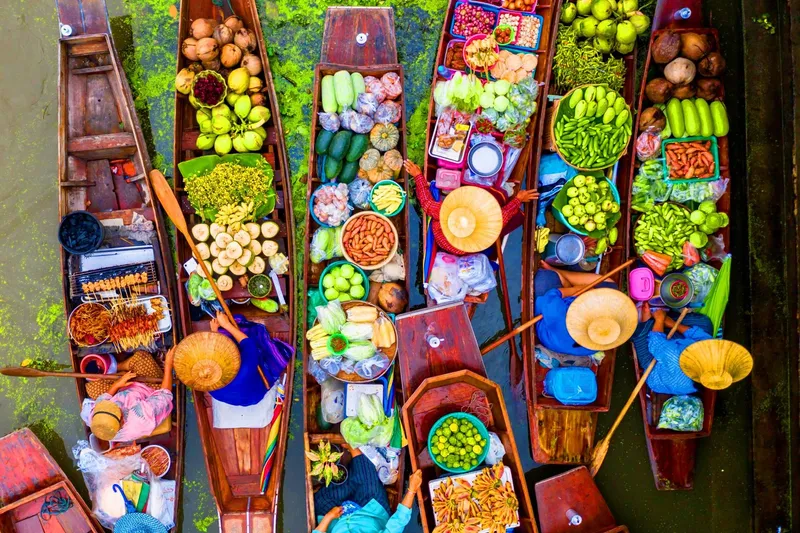
You pass within arm's reach of the paddle boats and motorised vendor vessels carrying rambutan, dragon fruit, green papaya, fresh-cut coconut, fried bananas, pad thai cooked to order on a portable burner, and sticky rice parcels wrapped in banana leaf. The noise, the smell, and the visual compression of dozens of boats in a narrow canal is something genuinely difficult to capture in a photograph — being there in person is the only way to understand the scale of it.
On the Market on Foot
After the boat ride, you have free time to explore the market's walkways and fixed stalls on foot. This part of the visit is more relaxed — you can sit at a canal-side stall for a proper Thai iced tea, browse the craft and souvenir stalls at your own pace, or simply find a good angle for photography. Food from the fixed stalls tends to be slightly calmer and easier to order than from the moving vendor boats, though both are worth trying.
A budget of 200 to 400 Thai baht covers a full street food lunch here with change to spare.
The Dual Market Difference: Why 10 Hours Changes Everything
Shorter floating market day trips from Bangkok typically run six to seven and a half hours. That is usually enough time to see the floating market briefly and catch the train at Maeklong, but it leaves little room for anything beyond the headline moments. This 10-hour tour is structured differently: the longer day allows for a more relaxed pace at each stop, additional time at the floating market for both the boat ride and a proper walkabout, a fuller visit to Maeklong with time to explore the market after the train passes, and potentially an additional stop — such as a coconut sugar farm, a local temple, or a riverside village — that shorter tours do not include.
The Combo No Other Market Day Delivers
What makes the floating market and train market pairing so effective is the contrast. The floating market is colour, movement, and sensory abundance — a scene built around water, boats, and the open-air exchange of food. The railway market is stillness interrupted by spectacle — a quiet local market that twice an hour becomes one of the most surreal sights in the country.
Together, they represent two completely different faces of Thai market culture, both genuine, both extraordinary in their own way, and both within an hour of each other west of Bangkok. No other day trip from the city delivers that contrast as cleanly.
- Floating market: colour, canal chaos, and boat-to-boat commerce
- Train market: local produce, quiet stalls, and the world's most improbable railway
- Combined in a single day with guided transport, local expertise, and all logistics handled
- 4.7-star rating across 5,183 independent reviews confirms the experience delivers on every count
Your 10-Hour Day at a Glance
-
07:00
Hotel pick-up in Bangkok
Your guide or driver collects you from your hotel or a central Bangkok meeting point. The drive to the floating market takes approximately 1.5 hours by air-conditioned vehicle — your guide uses this time to introduce the day's itinerary and share background on both markets.
-
08:30
Arrival at the floating market canal pier
Brief orientation with your guide before boarding the longtail boat. The group is small enough to board quickly and move through the canal without the queuing common on larger group tours.
-
08:45
Longtail boat ride through the floating market canals
Guided ride through the main market canal and the smaller side waterways. The guide narrates as you pass vendor boats, temple piers, traditional canal-side homes, and the busiest sections of the market. Duration is approximately 40 to 50 minutes.
-
09:30
Free time to explore the floating market on foot
Walk the market's covered walkways and open-air stalls at your own pace. This is the time to try local food, browse souvenirs, and take photographs from the canal bridges. The extra time here compared to shorter tours means you can sit, eat, and browse without feeling rushed.
-
10:30
Depart for Maeklong Railway Market
Board the vehicle for the 20 to 30-minute drive to Samut Songkhram Province. Your guide briefs you on the train schedule and the history of the Mae Klong line during the drive.
-
11:00
Arrive at Maeklong Railway Market
Walk the track lined with fresh produce stalls — fish, vegetables, spices, dried goods, and cooked food. Your guide positions the group at the optimal point along the track before the train is due to pass.
-
11:15
Watch the commuter train pass through the market
The station whistle sounds, vendors fold their striped awnings back over their goods and slide stalls off the rail, the train passes within centimetres of the merchandise, and the entire market resets in under two minutes. It happens on a loop, multiple times per day — your guide times the arrival so you do not miss it.
-
11:30
Free exploration of Maeklong market and optional street food
With the train seen, the rest of the Maeklong stop is yours to use as you like. Walk the track, browse the fresh fish and vegetable stalls, try local snacks, or simply photograph the market at your own pace. The full visit here runs to approximately 60 to 75 minutes — longer than most shorter tours allow.
-
12:30
Board vehicle for return journey to Bangkok
Air-conditioned return to Bangkok. Your guide can suggest afternoon or evening activities in the city based on your interests. Drop-off at the original meeting point or your hotel.
-
14:00–15:00
Estimated return to central Bangkok
Arrival time varies with Bangkok traffic conditions. The full 10-hour tour structure gives a comfortable buffer before Bangkok's afternoon rush, leaving you with the remainder of the day free.
Important Things to Know
What to Bring
A camera or fully charged phone is the most important item — both markets offer extraordinary photography at every turn. Bring a portable charger if your battery does not reliably last a full day. Wear lightweight, breathable clothing appropriate for outdoor walking in Thailand's heat; quick-dry fabrics are ideal.
Closed-toe shoes that you do not mind getting slightly splashed are recommended for the longtail boat ride, particularly if you sit near the front. Bring Thai baht in small denominations — 20 and 50 baht notes are the most practical for market purchases, street food, and optional extras. There are no reliable ATMs inside either market, so withdraw cash in Bangkok before departure.
Sunscreen and a hat are important, as both markets have open stretches with little shade, particularly at Maeklong. A compact rain jacket or poncho is smart between June and October.
- Camera or fully charged phone (portable charger recommended)
- Comfortable closed-toe shoes — expect some canal splash on the boat
- Thai baht in small notes (20 and 50 baht) — no ATMs at the markets
- Sunscreen and a hat for exposed sections at Maeklong
- Lightweight rain layer during the June–October rainy season
Not Allowed
Standing in the longtail boat at any point during the canal ride is not permitted — the guide will ask everyone to remain seated throughout for safety. Do not reach out to touch or handle vendor produce on the canal boats without intending to buy; this is considered impolite and can lead to pressure from vendors. Large suitcases and oversized luggage are not appropriate for this tour; a day bag or small backpack is the right choice.
Flash photography directly in vendors' faces is frowned upon at both markets — ask with a gesture or a smile before photographing someone close-up.
Early Departure Note
Pick-up begins at approximately 07:00 or earlier depending on your hotel's location in Bangkok. The floating market is most active and most beautiful in the early morning — the later the arrival, the less vendor activity you will see and the hotter the canal section becomes. This early start is one of the reasons the tour is so rewarding: arriving before 09:00 at the floating market means you see it at its most vibrant.
Set your alarm the night before and lay out your bag to make the early pick-up as smooth as possible.
Who This Tour Is For
Best For
This tour is ideal for travellers visiting Bangkok for the first time who want a structured, expertly guided introduction to two of central Thailand's most distinctive experiences. It suits photography enthusiasts — the floating market canal and the Maeklong train passage are both scenes that reward careful composition and patience. Couples and small groups tend to rate this tour particularly highly for its pace and the natural variety of the two-market format.
Travellers with limited time in Thailand who want to see something genuinely memorable beyond the Bangkok city temples will find this hits the mark. Anyone who has done the shorter, budget version of the floating market day trip and wants a more relaxed, more complete version of the same experience will notice the difference that the extra hours make.
- First-time visitors to Bangkok looking for an authentic, guided Thai experience beyond the city temples
- Photography enthusiasts — both markets are among the most photogenic locations in the country
- Couples and small groups wanting a comfortable, well-paced full-day excursion
- Travellers who have heard about the train market and want to see it properly rather than as an afterthought
Not Suitable For
This tour is not recommended for travellers with significant motion sickness, as the longtail boat involves engine vibration and canal movement that can be uncomfortable over 40 to 50 minutes. The tour is not wheelchair accessible due to the uneven boarding process for the canal boat and the narrow, sometimes crowded market terrain at both stops. Very young children may find the longtail engine noise startling and the long travel times tiring; families with children under six should consider shorter alternatives.
Travellers who strongly dislike crowded, humid outdoor markets in hot weather may find peak-season morning conditions at the floating market challenging — it is a working market, not a sanitised tourist attraction, and the sensory intensity is part of the experience.
Frequently Asked Questions
What is the difference between this tour and the shorter floating market day trips from Bangkok?
This tour runs for a full 10 hours compared to the six to seven and a half hours offered by shorter alternatives. The extra time is spread across both markets — more time at the floating market for the boat ride and a proper walkabout, and a longer stop at Maeklong to explore beyond the train moment itself. The guided experience is also more detailed, with more context provided about both the history of the canal markets and the Maeklong Railway line. At $35 it costs more than budget versions, but the unhurried pace and additional depth make it the better choice for travellers who want a complete day rather than a highlights-only visit.
Is the train market visit guaranteed — will the train actually pass through while we're there?
Yes. Your guide times the arrival at Maeklong Railway Market specifically to coincide with a scheduled train pass. The Mae Klong commuter line runs eight round trips per day on a consistent timetable, and guides who work this route know the schedule precisely. Barring rare service disruptions, you will see the train pass through the market during your visit. If the first train misses the group's window for any reason, there is typically another pass within 30 to 60 minutes.
How early does the tour start and why does it leave so early?
Pick-up from Bangkok hotels typically begins around 07:00, with the specific time depending on your hotel's location. The early departure is intentional: the floating market is most active and most visually rewarding in the morning, typically between 08:00 and 10:00, when vendor boats are at their busiest and the light is ideal for photography. Arriving later means fewer boats on the canal, less activity, and hotter conditions for the outdoor walks. The early start is consistently cited in traveller reviews as one of the decisions that makes this tour work as well as it does.
How much spending money should I bring for the markets?
The tour price covers transport, the guided boat ride, and the guide throughout the day — market purchases are your own expense. A budget of 400 to 600 Thai baht (roughly $12–$18 USD) covers a street food lunch at the floating market, drinks at both stops, and a small souvenir if you want one. Bring small-denomination notes — 20 and 50 baht bills are the most useful as market vendors rarely have change for 500 or 1,000 baht notes. There are no ATMs inside either market, so withdraw cash in Bangkok before departure.
What else can I do in Bangkok besides the market tour?
Bangkok offers one of the most diverse ranges of day trips and city experiences in Southeast Asia. From temple visits at Wat Pho and the Grand Palace to Chao Phraya river cruises, Muay Thai evenings, canal bike tours, elephant sanctuary trips to Chiang Mai, and day trips to Ayutthaya's ancient ruins — there is enough to fill two weeks without repeating yourself. Browse the full collection of bangkok thailand tours to plan the rest of your itinerary around your dates and interests.
What Travellers Are Saying
The train market was worth the entire day on its own — nothing I had read or watched online prepared me for what it looks like in person when that train comes through. Vendors just calmly fold everything back as if it is the most normal thing in the world. Then there is the floating market, which was equally extraordinary. Being on a boat at canal level with vendor boats all around you, food being cooked two metres away, the whole thing moving and chaotic and wonderful — this is exactly why you travel. One of the best days I have ever had anywhere.
We had done a shorter market day trip on a previous Bangkok visit and decided this time to book the full 10-hour version. The difference is real. There is no rushing, you actually have time to eat properly at the floating market, and the extra time at Maeklong means you can walk the whole track and explore the stalls after the train passes rather than being herded back to the bus. Our guide was knowledgeable and good company throughout the whole day. Easily the best structured tour we took in Thailand.
I was on a solo trip and slightly nervous about joining a group tour, but this was a great experience from start to finish. The group was small, the guide was attentive, and both markets were genuinely remarkable. I have been talking about the Maeklong train market to everyone who will listen since I got home — it is absurd and wonderful and I cannot believe it is real. The longtail boat ride at the floating market was the other highlight. Wet shoes, great photos, unforgettable morning. Book it.