Bangkok Food Tour Chinatown Street Food — 10 Dishes in Yaowarat for $45 (2026)
The Bangkok food tour Chinatown street food experience at $45 is the most delicious 3 hours you can spend in Thailand's capital: a local guide navigates the neon-lit chaos of Yaowarat Road, stopping at the stalls that matter most for 10 authentic dishes that define Bangkok's Chinese-Thai culinary identity. Rated 4.8 stars across 834 independent reviews, this evening walking tour is consistently ranked Bangkok's top street food experience. Everything you need to know is below — or browse all best bangkok food tours to find the right option for your trip.
About This Activity
Cancel up to 24 hours before — full refund
No upfront payment required
Evening tour starting around 18:00
Oyster omelette, dim sum, char kway teow and more
Bangkok's most atmospheric night food district
Bangkok's top-rated Chinatown street food tour
Check Live Availability & Prices
Real-time dates and pricing — free cancellation up to 24 hours before departure.
What You'll Eat — 10 Dishes in Yaowarat
Oyster Omelette (Hoy Tod)
The undisputed signature dish of Bangkok's Chinatown and the one that most visitors remember longest. Hoy tod is a crispy-edged egg omelette packed with fresh oysters or mussels and bound with a chewy rice flour batter, served with a tangy sriracha-style sauce. Bangkok's best versions are cooked in carbon-blackened woks over fierce heat — the smoke and char are essential to the flavour.
Your guide knows precisely which Yaowarat stall produces the lightest batter and the freshest shellfish on any given evening.
Dim Sum (Tiamsim)
Chinatown Bangkok has been making dim sum since the first wave of Teochew Chinese immigration in the 19th century, and Yaowarat's dim sum is resolutely old-school — no fusion, no gimmicks. Expect steamed har gow (shrimp dumplings) with translucent skin thin enough to see the filling, fluffy bao filled with barbecue pork, and crisp-bottomed pan-fried dumplings. The stalls on this tour have been run by the same families for generations: the technique is in their hands as much as in the recipe.
Char Kway Teow (Pad See Ew)
Thick flat rice noodles wok-fried with Chinese broccoli, egg, and your choice of pork, chicken, or tofu over a flame hot enough to produce the essential 'wok hei' — that distinct smoky breath that no home kitchen can replicate. Bangkok's version is slightly sweeter and saucier than its Malaysian or Singaporean cousins, reflecting the Teochew influence on Thai-Chinese cooking. This is the kind of dish that makes you understand why people fly to Bangkok just to eat.
Steamed Fish Maw Soup
A Chinatown classic that is largely unknown outside Bangkok's Chinese community. Fish maw — the dried air bladder of a fish, rehydrated and simmered — absorbs broth like a sponge and delivers a silky, collagen-rich texture. The Yaowarat version is typically seasoned with white pepper, ginger, and a dash of Shaoxing wine.
It is warming, deeply savoury, and utterly unlike anything most international visitors have tasted before arriving in Bangkok's Chinatown.
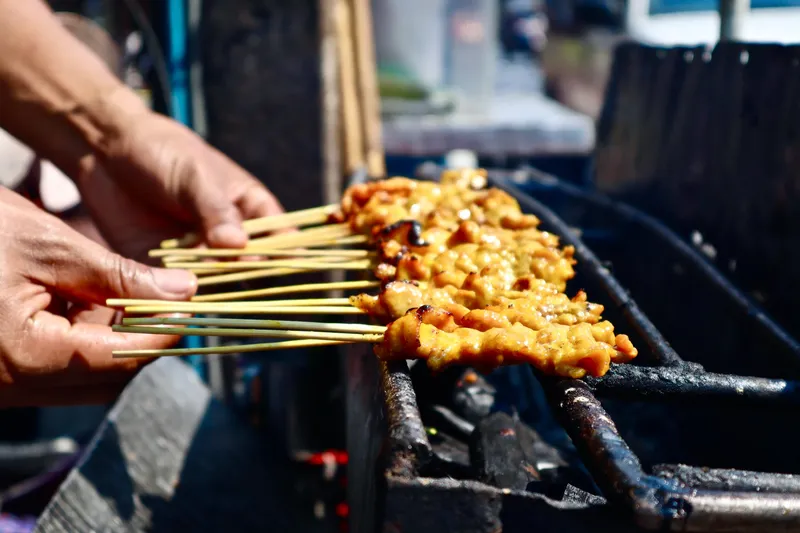
Satay Skewers (Moo Satay)
Thailand's satay differs from the Indonesian version in its marinade — Bangkok versions use lemongrass, galangal, and coconut milk, giving the pork or chicken a golden colour and a fragrant tropical sweetness. They are grilled over charcoal to order, served with thick peanut sauce and a side of ajad (cucumber relish in sweet vinegar). The charcoal stalls along Yaowarat's side streets are best experienced while standing — take a skewer in each hand and watch the city go by.
Braised Duck on Rice (Khao Na Ped)
A Teochew Chinese dish that has become as Thai as it is Chinese after 150 years in Bangkok. Dark-soy-braised duck is sliced and laid over jasmine rice, then ladled with the braise liquid — rich with five spice, soy, and star anise — and finished with a sprinkle of crispy garlic. Yaowarat's braised duck shops are some of the oldest food businesses in Bangkok, and the braise pots at the best stalls have been simmering continuously for decades.
Mango Sticky Rice (Khao Niao Mamuang)
Thailand's most beloved dessert, and in Yaowarat it is made to a standard that will reset your expectations. Glutinous rice steamed and soaked in sweetened coconut cream, served alongside slices of ripe, gold-fleshed Nam Dok Mai mango. The rice should be glossy and fragrant; the mango should be just past firm, intensely sweet.
This dish is deceptively simple, and Bangkok's version — when made correctly with the right mango variety and fresh coconut cream — is incomparably good.
Grilled Pork Skewers with Sticky Rice (Moo Ping)
Moo ping — charcoal-grilled pork skewers marinated in fish sauce, palm sugar, and garlic — are Bangkok's default street food at any hour. In Yaowarat at night they come from vendors who grill to order, turning each skewer by hand over glowing charcoal. The exterior is caramelised and slightly charred; the interior stays juicy.
Served with a bag of sticky rice, this is the dish Bangkokians eat when walking through the night market without stopping.
Thai Iced Tea (Cha Yen)
Cha yen — strong black tea brewed with star anise and other spices, poured over ice and mixed with sweetened condensed milk — is the palate reset between dishes. The colour is an improbable orange-amber, and the sweetness is calibrated to cut through the richness of fried and braised dishes. Your guide will time the cha yen stop strategically: usually after the heavier dishes, before the dessert course.
Bangkok's street tea is brewed in fabric socks suspended over enormous aluminium urns — watching it made is half the pleasure.
Sesame Balls (Jian Dui)
The tour finishes on a satisfying note: fried sesame balls — glutinous rice dough filled with lotus paste or black sesame, rolled in sesame seeds and deep-fried until golden and puffy. The exterior is crisp and sesame-nutty; the interior is soft and gently sweet. In Yaowarat, jian dui are made fresh throughout the evening by vendors who have been selling them from the same corner for generations.
Eat them hot from the fryer for the full textural contrast.
Why Chinatown is Bangkok's Best Street Food District
150 Years of Teochew Chinese Cooking in One Kilometre
Bangkok's Chinatown — Yaowarat — was established by Teochew Chinese immigrants in the late 18th century when King Rama I moved them from their original settlement to make way for the Grand Palace. The community that took root along Yaowarat Road brought with them an entire culinary tradition: dim sum, braised meats, fish maw soups, sesame sweets, and the technique of cooking over fierce wok heat that defines so much of Thai-Chinese street food today.
What makes Yaowarat exceptional is not just the age of its food culture but its density and authenticity. Within a single kilometre of Yaowarat Road and its connecting lanes, more world-class street food is concentrated than in entire neighbourhoods of other major Asian cities. The stalls that have survived here have done so on merit alone — there is no tourist subsidy for mediocre food in Chinatown.
- Yaowarat Road: Bangkok's oldest and most concentrated street food corridor
- Teochew Chinese culinary tradition preserved for six generations of Bangkok families
- Evening hours (18:00–22:00) are peak time — stalls at full production, atmosphere at maximum
- Dishes you will not find elsewhere in Thailand: fish maw soup, jian dui, authentic har gow
- A local guide is essential — the best stalls are hidden in lanes tourists rarely enter
Evening Is the Only Time to Go
Yaowarat during the day is a gold market district — jewellery shops and trading houses, relatively quiet. After sunset it transforms. The folding tables come out, the charcoal grills ignite, the woks go onto the burners, and Yaowarat Road becomes one of the most alive stretches of city in Southeast Asia. By 18:00 the best stalls are already busy. By 19:30 the street is at full saturation — neon signs reflecting on wet asphalt, the smell of charcoal and fish sauce and sesame oil layered over each other, tuk tuks threading between diners who have pulled chairs into the road.
This is the Bangkok food tour Chinatown street food experience you have seen in food documentary films. The evening start time on this tour is not arbitrary — it is the only time Yaowarat makes complete sense as a destination.
Evening 3-Hour Itinerary — Bangkok Food Tour Chinatown
-
18:00
Meet your guide at the Yaowarat Road entrance
Group gathers at the Odeon Clock Tower at the eastern end of Yaowarat Road — the landmark arch that marks Chinatown's main entry. Guide introduces the evening, explains the food culture context, and sets expectations for 10 dishes across the next 3 hours.
-
18:15
Stall 1 — Dim Sum (Har Gow & Char Siu Bao)
First stop is a family-run dim sum kitchen operating out of a shophouse on a side lane off Yaowarat. Steamed shrimp dumplings and barbecue pork bao, made fresh throughout the evening. Guide explains the Teochew Chinese origins of Bangkok's dim sum tradition while the kitchen steams your order.
-
18:40
Stall 2 — Oyster Omelette (Hoy Tod)
The tour's marquee dish: a wok-fried oyster omelette at the stall the guide considers Yaowarat's finest. Watch the cook work with a carbon-black wok over a flame that would set off most fire alarms. The result — crispy edges, juicy oysters, chilli sauce on the side — is Bangkok street food at its most iconic.
-
19:00
Stall 3 — Braised Duck on Rice & Fish Maw Soup
A Teochew-style braise shop for two dishes in one stop: dark-soy braised duck over jasmine rice, and a bowl of fish maw soup. The guide explains why fish maw became a prestige ingredient in Bangkok's Chinese community and how the braise pots here have been kept simmering for decades.
-
19:25
Cha Yen break — Thai iced tea
A palate reset at a street tea vendor midway through Yaowarat Road. Watch the brewing process: strong spiced black tea strained through a fabric sock, poured over ice in a plastic bag, finished with condensed milk. The sweet-and-bitter combination is calibrated perfectly for the dishes ahead.
-
19:40
Stall 4 — Char Kway Teow (Flat Rice Noodles)
Flat rice noodles wok-fried over maximum heat with Chinese broccoli, egg, and your protein choice. The wok hei — the smoky breath of a properly fired wok — is the defining characteristic of this dish and impossible to produce without commercial-grade flames. This stall is consistently cited in the tour's reviews as one of the best single dishes of the evening.
-
20:00
Stall 5 — Moo Ping & Satay Skewers
Side-by-side charcoal grill stalls near the western end of Yaowarat: one for Thai-style satay with peanut sauce, one for moo ping with sticky rice. Stand and eat — the Bangkok way. Guide explains how the lemongrass-and-coconut marinade in Thai satay differs from Indonesian-style versions.
-
20:25
Stall 6 — Mango Sticky Rice & Sesame Balls
Dessert double: fresh mango sticky rice at a fruit stall using Nam Dok Mai mangoes at peak ripeness, followed by hot sesame balls (jian dui) from a fryer stall that has occupied the same corner for over 30 years. Eat the jian dui immediately — they are best within 60 seconds of the fryer.
-
20:50
Final walk through Yaowarat Road at full evening atmosphere
With all 10 dishes complete, the guide leads a final walk the full length of Yaowarat Road — now at peak evening energy — pointing out temples, gold shops, and the architectural layers of 150 years of Chinese-Thai urban history before the group disperses at the Odeon Clock Tower.
-
21:00
Tour ends at the Odeon Clock Tower
Official end of the Bangkok food tour Chinatown street food experience. Guide suggests options for continuing the evening independently — additional street food, the nearby temples, or tuk tuk connections to Khao San Road or the BTS network.
Important Things to Know Before You Go
What to Bring
- Comfortable walking shoes — Yaowarat's side lanes have uneven pavements and you will cover ground continuously for 3 hours
- Loose, breathable clothing — evening temperatures in Bangkok remain warm and the crowds add to the heat
- Small cash in Thai Baht — bring 200–400 THB for any additional street food or drinks you want beyond the 10 included dishes
- Hand sanitiser — essential for a walking street food tour with multiple stall stops
- Phone charged for photos — Yaowarat at night is one of Bangkok's most photogenic locations
Allergy Information
Thai street food, and Chinatown street food in particular, uses fish sauce, shrimp paste, and dried seafood as foundational seasonings across almost every dish — including many that do not appear seafood-based. Guests with severe shellfish or seafood allergies should consult the GetYourGuide booking page before reserving and declare allergies at booking. The tour is not suitable for those with anaphylactic-level shellfish allergies due to the cooking environment and shared surfaces throughout Yaowarat.
- Fish sauce and shrimp paste are present in most savoury dishes — this is unavoidable in this culinary tradition
- Oyster omelette (hoy tod) is a featured dish — those with oyster/shellfish allergies should notify the guide immediately
- Vegetarian and vegan options are available but venue choice will be limited — declare at booking
- Gluten-free adaptation is not possible across all 10 dishes due to soy sauce and rice flour usage in multiple stalls
Not Allowed
- Large backpacks or wheeled luggage — Yaowarat's market lanes are narrow and crowded; small day bags only
- Dietary restrictions added mid-tour without prior declaration at booking — the guide pre-orders at most stalls
- Photographing stall vendors or kitchen staff without asking permission first — always check with the guide before pointing a camera at individual vendors
Who This Tour Is For
Best For
- Food travellers who want to eat what Bangkok actually eats — not tourist-menu approximations
- First-time Bangkok visitors who want the most memorable food experience in the least time
- Experienced Southeast Asia travellers looking to go deeper into the Teochew Chinese-Thai culinary tradition
- Solo travellers — the evening format and small group structure make it easy to connect with fellow food lovers
- Couples who want a meaningful, flavour-led alternative to a restaurant dinner in Bangkok
Not Suitable For
- Those with severe seafood or shellfish allergies — fish sauce and shrimp paste are foundational to virtually every dish served across Yaowarat's stalls, and the oyster omelette is a key feature of this tour
- Guests unable to walk for 3 consecutive hours on uneven market surfaces — the tour is a continuous walking experience through active, crowded street markets with no seating between stalls
Bangkok Food Tour Chinatown Street Food — FAQs
What are the 10 dishes included in the Bangkok Chinatown street food tour?
The 10 dishes are: har gow and char siu bao (dim sum), oyster omelette (hoy tod), braised duck on rice (khao na ped), fish maw soup, char kway teow (flat rice noodles), Thai iced tea (cha yen, as a palate cleanser), pork satay with peanut sauce, moo ping (grilled pork skewers with sticky rice), mango sticky rice (khao niao mamuang), and sesame balls (jian dui). The guide may adjust specific dishes based on quality and freshness on the night, but the total is always 10.
Is the Bangkok Chinatown food tour suitable for vegetarians?
It can be accommodated with advance notice, but it is not a naturally vegetarian-friendly experience. Thai and Chinese street food in Yaowarat uses fish sauce, shrimp paste, pork fat, and shellfish as baseline seasonings across most dishes. Vegetarian alternatives exist at some stalls — tofu in the noodles, vegetable bao — but the tour was designed around the classic Chinatown meat and seafood canon. Declare vegetarian or vegan requirements at booking so the guide can plan accordingly.
What time does the Bangkok Chinatown street food tour start and is evening the right time?
The tour starts at 18:00 and runs until approximately 21:00. Evening is not just the right time — it is the only time. Yaowarat's street food stalls do not operate during the day; the district functions as a gold and jewellery trading area until sundown. After 18:00, the stalls deploy, the charcoal grills ignite, and the atmosphere transforms into the neon-lit street food spectacle that Chinatown is famous for. The 4.8-star rating reflects the tour's timing — you are there exactly when Yaowarat is at its best.
How difficult is the walking on the Bangkok Chinatown food tour?
The tour covers the length of Yaowarat Road and several connecting market lanes over 3 hours — a total of roughly 2–3 kilometres at a leisurely pace with frequent stops. The terrain is urban street pavement, some of which is uneven, cracked, or obstructed by vendor equipment. The pace is relaxed and determined by the guide and group. Comfortable, closed-toe shoes are strongly recommended. The tour is not suitable for guests with significant mobility limitations.
Where can I find more Bangkok food tours beyond Chinatown?
The Chinatown night tour is one of the most specialised options in Bangkok, but the city has a full range of food experiences — cooking classes, canal-side food tours, floating market visits, and multi-district food crawls. Browse all food tours bangkok thailand to compare options by duration, district, and style, and find the right match for your time in Bangkok.
What Travellers Say About This Bangkok Chinatown Street Food Tour
Absolute highlight of my Bangkok trip. Our guide knew every stall owner by name and ordered in Thai like a regular — no tourist menus, no upselling, just the real thing. The oyster omelette alone was worth the $45. Ate 10 dishes and could have kept going.
I have done food tours on four continents and this is top three, easily. Yaowarat at night is a sensory overload in the best possible way — the guide kept us moving at the perfect pace, explained the cultural history behind every dish, and took us down lanes I would never have found alone. Book it.
Came as a solo traveller and ended up spending the rest of the evening exploring with two people I met on the tour. The food was extraordinary — the fish maw soup and mango sticky rice were things I had never tasted before. Already recommending this to everyone visiting Bangkok.