Bangkok Must-Try Hidden Bike Food Experience — Full Review (2026)
The best street food in Bangkok is not in the places that appear on travel blogs. It is in the lanes behind those lanes — in neighbourhood markets, alley noodle stalls, and canal-side vendors that cater exclusively to locals. This 3-hour bicycle tour reaches those places on two wheels, stopping at 8 hidden food spots that no tuk-tuk or taxi could pull up to. Rated 4.9 stars from 317 verified traveler reviews, it is consistently one of the most praised food experiences among all Bangkok Thailand tours. Here is everything you need to know before you book.
About This Activity
Cancel up to 24 hours before the tour — full refund guaranteed, no questions asked
Secure your spot today without any upfront payment required
Morning departure — typically 08:00 start, finishing by 11:00 before midday heat
Quality city bicycle and helmet provided at no extra charge for all participants
Local noodle stalls, canal-side vendors, neighbourhood markets — all off the tourist circuit
One of Bangkok's highest-rated food and cycling experiences on GetYourGuide
Check Live Availability & Prices
Real-time dates and pricing — free cancellation up to 24 hours before departure. Morning slots fill quickly, especially during high season from November through February.
What Makes This a 'Hidden' Food Tour
Bangkok has two food cities. The first is the one that appears in every travel guide: Yaowarat Road's Chinatown neon, Chatuchak's weekend market stalls, the Pad Thai restaurants clustered around Khao San Road. These places are genuinely good — but they are also adapted to tourist volume. Prices reflect visitor expectations. Portion sizes, spice levels and even recipes edge toward international palatability.
The second food city runs parallel to the first, invisible from the windows of tourist transport. It is the noodle stall that has served the same six dishes to the same neighbourhood for thirty years. The canal-side vendor who sets up her wok at 07:30 and sells out by 09:30 because the surrounding community knows what time to arrive. The wet market where three generations of the same family have sold fresh produce since before the tourist infrastructure of the neighbourhood was built.
This tour reaches the second city. The guide has spent years developing relationships with the vendors and communities along the cycling route — relationships that are evident from the first interaction. When the group arrives at a stop, the guide does not simply translate a menu. He explains where the vendor learned the recipe, what the dish means in local food culture, and why this particular stall has retained a loyal neighbourhood following despite (or because of) never advertising to tourists.
The 4.9-star rating from 317 independent reviews reflects what this access makes possible: a food tour that feels like an invitation rather than a transaction.
- Off-tourist-path neighbourhoods where food vendors cater exclusively to local residents
- 8 stops chosen for authenticity, not Instagram visibility — the guide's personal list, not a tour operator's packaged circuit
- Canal-side and market-lane locations inaccessible to tuk-tuks, taxis and tour buses
- Guide has long-term relationships with vendors along the route — context and conversation, not just translation
- 4.9 stars from 317 verified reviews — consistently praised for access, guide knowledge and food quality
The Bicycle Route and Bangkok Neighbourhoods You'll Explore
Off-Tourist-Path Neighbourhood Lanes
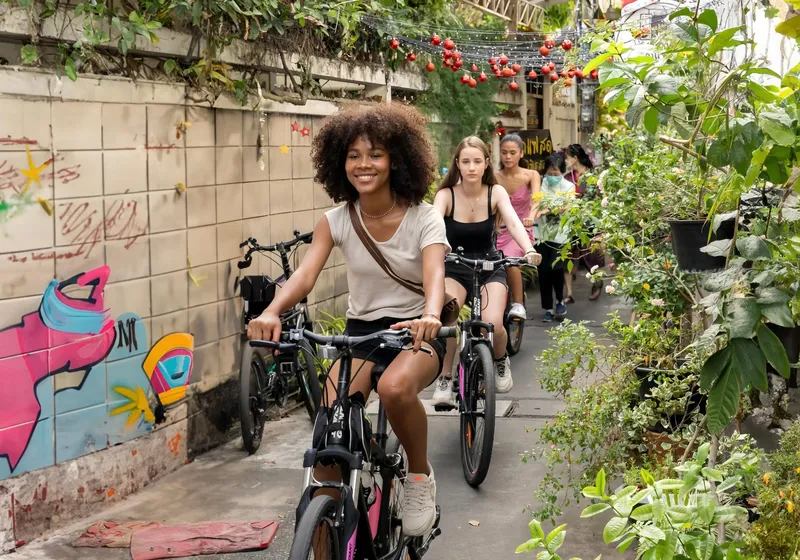
The cycling route runs through residential Bangkok — the interconnected network of narrow lanes (sois) that branch off the main roads and disappear into blocks of houses, shophouses and small community temples that receive no meaningful tourist traffic. These sois connect in ways that are confusing on a map and intuitive on a bicycle: the guide knows which lane leads to which vendor, which shortcut avoids the school drop-off hour, and which stretch of canal path offers the best view of the morning light.
Riding through these lanes by bicycle, the group becomes temporarily part of the neighbourhood morning rhythm: the school run, the temple merit-making, the market shopping, the coffee-and-newspaper routine of older residents at street-corner tables. The pace of the tour is calibrated to this rhythm — slow enough to observe and experience, fast enough to cover the full route in 3 hours.
- Residential sois impassable for vehicles wider than a bicycle or motorbike
- Community shophouses, neighbourhood temples and canal-facing houses along the route
- Morning neighbourhood activity — school runs, merit-making, market shopping visible from the saddle
- Guide navigates by local knowledge, not GPS — the route changes seasonally based on vendor hours and market days
- No tourist infrastructure along most of the route — the group is the only visiting presence
Canal-Side Cycling and Floating Vendors
Bangkok's khlong (canal) network predates its road system. In the neighbourhoods the tour passes through, the canals are still in use: as transport routes for loaded wooden boats, as the water supply for canal-side gardens, and as the setting for floating vendors who set up small boats stocked with ready-to-eat food for the canal-bank community.
The canal sections of the cycling route are among the most photogenic and memorable of the tour. The guide identifies the canal-side food spots in advance and times the route to arrive when the floating vendors are active — typically between 08:00 and 09:30. These vendors do not have fixed addresses, do not appear on any app, and are not marketed anywhere. Finding them requires the kind of local knowledge the guide has built over years of cycling the same canals.
- Canal-side cycling paths along Bangkok's working khlong network
- Floating food vendors accessible only from the canal bank — no road access or app listing
- Wooden boat traffic still in use for goods transport and canal community movement
- Route timed to reach canal vendors during their active selling hours (08:00–09:30)
- Canal-facing houses with stilt architecture visible from the path
Local Wet Markets and Morning Vendors
Two or three stops on the route fall in or around neighbourhood wet markets — the covered and open-air markets that Bangkok residents use for daily food shopping. These markets are not designed for tourists and the vendors are not accustomed to explaining their products to non-Thai speakers, which is exactly what makes the guide's role so valuable. He navigates the group through the market with context: who is selling what, what the preparation method is, what the dish is called in Thai, and which stall the surrounding residents rate as the best in the market for that particular item.
The wet market visits are food education in the most direct sense: not a cooking class or a tasting menu, but a working market encounter with someone who knows how to make it comprehensible and enjoyable for visitors who have never been to one before.
- Neighbourhood wet markets serving local residents — not tourist night markets or 'floating market' attractions
- Seasonal produce, fresh herbs, prepared dishes, and grilled-to-order street food in the same market
- Guide explains each vendor's specialism, pricing and preparation method in real time
- Markets open from 06:00 — the tour arrives at peak activity before the best stalls sell out
- No English signage, no tourist menus — the guide translates both language and context
What Foods You'll Try on the Hidden Bike Food Tour
The 8 food stops are not fixed to an identical menu every day — the guide adapts the stops based on what is freshest, what is in season, and what the vendors along the route are cooking that morning. What follows is representative of the kinds of dishes and stops the tour typically includes; the specific items vary by day and season.
Expect Thai food at its least compromised: the full spectrum of chilli heat that Thai cooking uses in the neighbourhood context (not dialled down for international palates), fermented and preserved ingredients that tourist restaurants rarely serve, textures and combinations that are distinctly different from what appears on the Khao San Road circuit.
- Jok (Thai rice congee) — the canonical Thai breakfast, served with ginger, spring onion and a soft-boiled egg from a canal-side vendor who makes it daily from scratch
- Kuay teow (boat noodles) — small, intensely flavoured portions of noodle soup with pork blood broth, traditionally served from boats along the canals
- Khanom krok (coconut rice pancakes) — cooked to order in a cast-iron pan on a street corner, crisp outside and liquid-centred, sweet and savoury simultaneously
- Mango sticky rice — from a wet market vendor who uses the Dok Mali jasmine rice variety that tourist restaurants typically substitute
- Grilled pork skewers (moo ping) — charcoal-grilled at a market stall, marinated in fish sauce, palm sugar and garlic, served with sticky rice in a bag
- Fresh tropical fruit — seasonal selection from a market vendor, cut and bagged for cycling; the guide identifies each fruit and explains seasonality
- Thai iced coffee or cha yen (Thai iced tea) — from a shophouse that has been serving the same recipe to the neighbourhood for decades
- A surprise stop — the guide reserves one stop each morning for whatever he finds that is particularly good that day; past examples have included deep-fried banana blossoms, palm sugar candy made on-site, and freshly pressed sugarcane juice
3-Hour Hidden Bike Food Tour — Full Itinerary
-
08:00
Meet and bicycle fitting
Meet your guide at the designated departure point in the neighbourhood. Bicycle selection and helmet fitting — helmets are mandatory and provided for all participants at no charge. Brief overview of the route, the 8 stops planned for the morning, and how to signal the guide if you need to stop. Questions welcomed before the group sets off.
-
08:15
Stop 1 — Canal-side breakfast jok stall
First food stop: a canal-bank vendor who has served Thai rice congee (jok) to the surrounding neighbourhood since before the adjacent road was built. Eaten from small bowls with fresh ginger, fried garlic and a soft-cooked egg. The guide explains the role of jok in the Thai breakfast tradition and why this vendor's version is regarded differently from the hotel breakfast alternative.
-
08:35
Canal-path cycling through residential sois
The route leaves the canal bank and threads into the residential lane network — narrow sois too tight for cars, lined with shophouses, community spirit houses and the daily life of a Bangkok neighbourhood that receives almost no tourist traffic. The guide provides commentary on what the group is seeing: architecture, community function, the visible markers of neighbourhood identity.
-
08:55
Stop 2 & 3 — Neighbourhood wet market
Two stops in quick succession at the neighbourhood morning market — first a vendor selling grilled moo ping (pork skewers) and khanom krok (coconut rice pancakes) cooked to order; then the fresh fruit vendor for a seasonal selection cut and bagged for the road. The guide navigates the market, explains each item, and handles the ordering. Eating while cycling is permitted on the residential lanes.
-
09:20
Stop 4 & 5 — Boat noodles and Thai iced coffee
The classic combination: a bowl of kuay teow boat noodles — small, intensely flavoured, with pork blood broth and a pile of bean sprouts — followed immediately by a glass of Thai iced coffee from the shophouse next door. The guide explains the boat noodle tradition and why the portions are intentionally small (the canal-boat original sold only small servings due to space constraints).
-
09:45
Canal floating vendor stop (Stop 6)
The route reaches the canal section timed for the floating vendor's active hours. The group parks bicycles and walks to the canal bank to buy directly from the vendor's boat. The specific item varies daily — this is the stop most frequently described in reviews as the experience that makes the tour unlike any other Bangkok food tour available.
-
10:15
Stop 7 — Mango sticky rice vendor
A wet market vendor known in the neighbourhood for using the Dok Mali jasmine rice variety and ripe Nang Kluay Nam Wa bananas alongside the mango — a combination that differs from the tourist-restaurant standard. The guide explains Thai rice varieties and why the quality of the sticky rice matters as much as the mango. A generous portion, eaten roadside before the final cycling section.
-
10:40
Stop 8 — Surprise stop and return
The guide's reserved morning pick: a stop chosen based on what he finds particularly good that day — past options have included freshly pressed sugarcane juice, deep-fried banana blossoms, or a canal-side vendor making palm sugar candy. After the final stop, the group cycles back to the departure point along a return route that passes through a different set of lanes, arriving by 11:00.
Important Things to Know Before You Go
What to Bring
The tour departs at 08:00 and runs until 11:00 — before peak Bangkok heat, but the sun is already strong from the first stop onward. Dress for outdoor cycling in tropical morning conditions.
- Light, breathable clothing — you will be cycling for 3 hours in Bangkok heat and humidity; natural fibres or technical fabric work best
- Closed-toe shoes — sandals and flip-flops are not safe on the bicycles and are not permitted
- Sunscreen applied before departure — canal paths and open market lanes offer limited shade
- Sunglasses — glare off the canal surface is intense in the morning sun
- Small backpack or cross-body bag — keeps hands free for food and photos during stops
- Camera or phone with storage — the canal vendor, market and neighbourhood lane sections produce photographs not available from any other vantage point
- Light appetite — 8 food stops are substantial; arriving very full will reduce the experience considerably
- Water bottle — water is available at the departure point but carry extra for the canal sections between stops
Not Allowed
- Cycling without a helmet — helmets are mandatory and non-negotiable for all participants throughout the cycling sections
- Deviating from the guide's route — the canal-path route is chosen for access and community respect; solo departures are not permitted
- Leaving the group unannounced — the guide must account for all participants, particularly on the canal-path and residential soi sections where mobile signal is limited
- Refusing food stops — the 8-stop food experience is the core of the tour; participants who decline all food stops significantly affect the group dynamic and are not the right fit for this tour
Cycling Fitness Level Required
The Bangkok hidden bike food tour is designed for casual cyclists, not athletes. The entire route is flat — Bangkok sits at river level, with no hills or meaningful inclines on the tour path. The pace is relaxed throughout, with the guide setting the speed for the whole group and frequent stops for food meaning the cycling sections are punctuated rather than continuous.
You must be able to ride a bicycle independently and confidently. The guide cannot provide physical assistance while cycling, and the route includes some canal-path sections where the guide needs to focus on navigating the group safely. If you can ride a bicycle without stabilisers at a comfortable park pace, you have the fitness level required.
Children aged 8 and over are welcome if they can ride a bicycle independently. Children under 8 or those who cannot ride unassisted cannot participate.
- Completely flat route — no hills, no inclines, Bangkok river-level terrain throughout
- Relaxed pace set by the guide — comparable to a leisurely park cycle with frequent food stops
- Must be able to ride a bicycle independently and confidently for up to 3 hours total cycling time
- Children aged 8 and over welcome if they can cycle independently without assistance
- Children under 8 or non-cyclists cannot participate — there is no non-cycling option
Who This Tour Is For
Best For
This tour is built for travelers who use food as the primary lens through which they understand a city — and who want that food to come from the places locals actually eat, not from the tourist-facing versions of those places.
- Food-first travelers who prioritise eating authentically over covering landmark attractions
- Active travelers looking for an experience that combines genuine exercise with cultural depth
- Photographers — the canal-path vendor, wet market, and neighbourhood lane sections produce images unavailable from tourist-circuit Bangkok
- Anyone who has already done the standard Bangkok food tours and wants to go further off the beaten path
- Couples and small groups looking for a shared experience that generates memorable conversation
- Travelers with a morning free who want to use it with maximum density of genuine Bangkok experience
- Families with children aged 8 and over who can cycle independently and have broad food curiosity
Not Suitable For
- Those who cannot ride a bicycle — cycling is the primary mode of transport throughout the tour; there is no walk-only alternative
- Those with significant dietary restrictions (severe allergies, strict veganism) — the guide will do his best but the hidden vendor format does not offer controlled ingredient lists
- Those with very low heat or spice tolerance who cannot manage authentic Thai street food heat levels — the guide can request mild preparations at most stops, but not all vendors offer reduced-chilli options
- Children under 8, or older children who cannot ride a bicycle independently without assistance
- Those planning to visit midday — this tour runs in the morning; the canal-path sections are not safe or comfortable in Bangkok's midday heat
Bangkok Hidden Bike Food Experience — FAQs
How much food is included in the 8 stops?
The 8 stops are genuine food portions — not small tastings. Most stops are a single dish or drink at full serving size, eaten at or near the vendor rather than sample-sized for a large group. The cumulative volume over 3 hours is equivalent to a substantial breakfast and mid-morning meal. The majority of reviewers describe leaving the tour satisfied and not needing to eat again until mid-afternoon. Come with a light appetite, not an empty stomach — you will eat a lot.
Is all the food safe to eat for travelers with sensitive stomachs?
The guide selects vendors with long track records and high local custom — busy neighbourhood stalls with fast ingredient turnover are inherently safer than low-traffic tourist-facing operations. That said, the food is authentic Bangkok street food: made with fresh ingredients, cooked at high heat, and subject to the normal variability of outdoor food preparation. Travelers with genuinely sensitive stomachs should eat cautiously at the first two stops and use those as a gauge. The guide is experienced with international participants and can advise at each stop.
Can I do this tour if I don't eat meat?
Partially. Thai street food culture is not inherently vegetarian-friendly — many dishes use fish sauce, shrimp paste or pork in ways that are not visible on the surface of the dish. The guide can identify which stops and which items on that morning's route are meat-free or fish-sauce-free, and substitute where possible, but the hidden vendor format does not offer the controlled menu of a restaurant. Strict vegetarians and vegans will find approximately 3–4 of the 8 stops easily navigable and the remainder more challenging. If vegetarian food is a firm requirement rather than a preference, contact the tour operator before booking.
What is the group size on the hidden bike food tour?
Small group, typically 6–12 participants. The small group format is a deliberate choice: larger groups cannot navigate the residential soi lanes without disrupting the neighbourhood, cannot approach the canal vendor in a way that preserves the experience, and cannot receive the individual guide attention that the food context requires. The 4.9-star rating from 317 reviews reflects what small group access makes possible — if the group were 20 people, the experience would be materially different.
How does this compare to other Bangkok food tours?
Most Bangkok food tours follow a similar circuit: Chinatown, the tourist market district, and a few photogenic vendors who have adapted their offering for international visitors. This tour does the opposite: the entire route is built around vendors who have no tourist-facing component whatsoever, accessed via cycling lanes that tour buses and tuk-tuks cannot enter. The bicycle is not incidental — it is what makes the access possible. For a full comparison of food experiences and cycling tours, see all Bangkok Thailand tours.
What Travelers Say About the Bangkok Hidden Bike Food Tour
I've done food tours in eight cities and this is the one I still think about. The canal-side jok vendor at 08:15, steam coming off the congee in the morning light, nobody around except the guide explaining the recipe — that is not a tourist experience. That is breakfast in Bangkok. Worth every baht and then some.
The boat noodle stop was the highlight. The guide explained why the bowls are intentionally tiny — the canal-boat tradition, the original vendors on the khlongs — and then we had four of them each because they were that good. That kind of context turns eating into understanding. I learned more about Bangkok in three hours on this tour than in three days of doing the temple circuit.
My partner and I are both food writers and we came to Bangkok specifically to eat. We booked this tour on day one and it set the standard for everything else. The floating vendor stop — a woman with a boat loaded with coconut desserts, selling to the canal-bank residents — was something I had not seen described anywhere. The guide found her by cycling the canal at 06:00 that morning to check she was operating. That level of commitment shows in every stop.