Bangkok Hop-On Hop-Off Bus (24/48/72h): The Complete Visitor's Guide
Bangkok is enormous — a sprawling city of 10 million people where tuk-tuks, elevated rail, river boats, and traffic-choked highways all compete for space. For first-time visitors trying to cover major sights without a fixed itinerary, the Bangkok Hop-On Hop-Off Bus is one of the most efficient ways to move between landmarks at your own pace. This guide covers every stop, the best use strategies, and what to realistically expect from your pass. For a broader look at getting around the city and booking activities, visit our bangkok thailand tours hub.
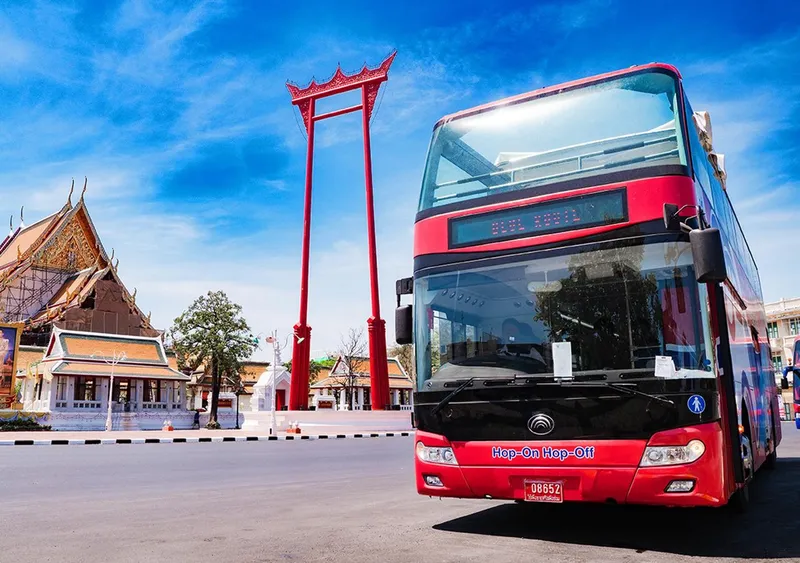
About This Activity
Cancel anytime before the experience starts for a full refund
Show your QR code directly from your phone — no printing required
Choose a 24-hour, 48-hour, or 72-hour pass — timer starts on first use
Multi-language commentary plays automatically at each stop via the onboard system
One circular route covering 15+ stops from Chinatown to Khao San Road and the Chao Phraya riverside
Rated 4.2 out of 5 by over 2,086 verified travelers on GetYourGuide
Check Availability & Book Your Pass
Select your pass duration (24, 48, or 72 hours) and pick a start date. The timer activates the moment you board for the first time, so you can book now and activate whenever you're ready.
How the Bangkok Hop-On Hop-Off Bus Works
The Route
The bus runs a single circular loop that connects Bangkok's most-visited tourist zones. Buses depart every 30–60 minutes depending on time of day, with shorter gaps during peak morning and late-afternoon hours. The full loop takes approximately 90 minutes to complete without stopping, so you can also ride it end-to-end as an orientation tour on arrival day.
Key Stops Along the Route
The route is designed to hit the dense cluster of attractions in Bangkok's old city first, then swing through the modern commercial districts before returning.
- Stop 1 – Khao San Road (backpacker hub, night market, street food strip)
- Stop 2 – Democracy Monument (historic landmark, walking distance to local cafés)
- Stop 3 – Ratchadamnoen Avenue (the royal boulevard, Grand Palace approach)
- Stop 4 – Grand Palace & Wat Phra Kaew (Bangkok's single most-visited attraction)
- Stop 5 – Wat Pho (Temple of the Reclining Buddha, Thai massage school)
- Stop 6 – Tha Tien Pier (Chao Phraya River access, cross to Wat Arun)
- Stop 7 – Chinatown / Yaowarat Road (street food, gold shops, Wat Traimit)
- Stop 8 – Hua Lamphong (central railway station, MRT interchange)
- Stop 9 – Patpong / Silom Night Market
- Stop 10 – Lumphini Park (green space, evening jog paths)
- Stop 11 – Erawan Shrine / Central World (shopping district, Hindu shrine)
- Stop 12 – Jim Thompson House (silk museum, teak house estate)
- Stop 13 – National Museum / Sanam Luang (royal ceremonial ground)
- Stop 14 – Wat Saket / Golden Mount (panoramic city views)
- Stop 15 – Siam Square / MBK Center (youth fashion, electronics)
When to Use the Bus vs. Other Transport
The hop-on hop-off bus is best used for sightseeing between temple clusters and riverside areas. For crossing the city quickly (e.g., airport to hotel, Sukhumvit to Silom), the BTS Skytrain or MRT Metro are faster. The Chao Phraya Express Boat is better for stops 4–7 if you're focused purely on the riverside corridor.
Where the hop-on hop-off wins: it connects areas that are awkward to link by rail — Khao San Road, Chinatown, Wat Saket, and Jim Thompson House have no direct Skytrain access.
Best Stop Order: Recommended One-Day Route
Bangkok's traffic builds quickly after 9:30am. Starting at temples early and moving to museums and markets in the afternoon gives you the best conditions at each attraction.
-
08:00
Board at Khao San Road (Stop 1)
Start here before the heat intensifies. Grab a coffee from one of the street vendors already open at 8am, then board the first bus of the day heading toward the Grand Palace.
-
08:45
Grand Palace & Wat Phra Kaew (Stop 4)
Arrive well before the main crowds, which peak from 10am onward. Budget 1.5–2 hours inside the complex — this is non-negotiable for a first visit. Dress code enforced: shoulders and knees covered. Sarongs available at the gate for rent.
-
10:45
Wat Pho – Temple of the Reclining Buddha (Stop 5)
A 10-minute walk from Stop 4, or re-board for one stop. The 46-metre reclining Buddha is one of the most impressive Buddhist artworks in Southeast Asia. Allow 45 minutes. The adjacent Thai massage school offers 30-minute sessions — a popular post-temple break.
-
12:00
Tha Tien Pier → Wat Arun (Stop 6)
Take the cross-river ferry (5 baht, less than $0.15) from Tha Tien Pier to Wat Arun, the Temple of Dawn. The mosaic-encrusted prang is best photographed from this side before noon. Climb the steep central tower for river views if you're comfortable with heights.
-
13:30
Chinatown / Yaowarat Road (Stop 7)
Re-board and ride to Chinatown for lunch. The road is lined with dim sum shops and seafood restaurants that serve from midday. This is also where you'll find Wat Traimit, home to a 5.5-tonne solid gold Buddha discovered accidentally in the 1950s.
-
15:30
Jim Thompson House (Stop 12)
Cross into the modern district for this unexpected highlight — a cluster of antique Thai teak houses filled with Asian art and silk collections. Guided tours run every 20 minutes and are included in the entry fee. The surrounding lanes have excellent independent coffee shops.
-
17:00
Erawan Shrine / Central World (Stop 11)
The Erawan Shrine sits at one of Bangkok's busiest intersections but feels strangely peaceful inside. Traditional dance performances happen throughout the day when worshippers commission them. Central World mall next door has food courts on the upper floors for an early dinner.
-
18:30
Return to Khao San Road or Silom (Stop 1 / Stop 9)
End the day either at Khao San Road for night market browsing and street food, or at Patpong / Silom (Stop 9) for the famous Patpong Night Market and evening dining along Silom Road.
Important Things to Know
What to Bring
A few essentials will make a significant difference to your comfort on the bus and at stops:
- Lightweight cover-up (sarong, scarf, or shirt) — required for all temple entry; temples will turn you away in shorts and sleeveless tops
- Cash in Thai baht — entrance fees at Grand Palace (500 baht), Wat Pho (200 baht), and Wat Arun (100 baht) are cash only at the gate
- Refillable water bottle — temperatures regularly exceed 33°C; vendors near stops sell water but the open-top deck dehydrates fast
- Sunscreen SPF 50+ and a hat — the upper deck is unshaded; the UV index in Bangkok averages 12–13 in the middle of the day
- Your QR code ticket — screenshot it before boarding in case of poor mobile data at certain stops
- Comfortable walking shoes — the stops themselves require considerable walking on uneven temple grounds and pavements
Not Recommended
Certain activities and expectations don't align well with the hop-on hop-off format:
- Using the bus as airport transfer — it does not serve Suvarnabhumi or Don Mueang airports
- Tight time scheduling — bus frequency drops in afternoon traffic and delays of 20–40 minutes are common between 3pm and 6pm
- Bringing large luggage — no storage on the bus; use your hotel luggage storage before starting
- Visiting the Grand Palace on a Monday afternoon — parts of the complex occasionally close for royal events with limited advance notice
- Relying solely on the bus for Wat Arun — you must take the cross-river ferry yourself; the bus does not cross the Chao Phraya
Tips for Getting the Most Out of the Pass
From frequent traveler patterns on this route, a few habits consistently improve the experience:
- Activate your pass on a morning when you plan a full day — the 24-hour clock runs from first scan, not from midnight
- Sit on the upper open-top deck for photos and audio commentary; the lower deck is air-conditioned but views are limited
- Download an offline Bangkok map (Maps.me or Google Maps offline) before starting — connectivity near temples is unreliable
- Check the bus app or route map for live bus locations if available; otherwise, budget 20-minute buffer at each stop
- 72-hour pass holders: spread temple-heavy stops across day one, museum and market stops across day two, and use day three for shopping districts and revisits
Who This Tour Is For
Best For
The Bangkok Hop-On Hop-Off Bus is particularly well-suited to certain travel styles:
- First-time visitors to Bangkok who want a low-stress way to cover the main sights without planning individual transport for each stop
- Travelers with 2–3 days in the city who want maximum flexibility without committing to guided group tours
- Families with older children (8+) who enjoy moving at their own pace and skipping stops that don't interest them
- Solo travelers who prefer structured route orientation before exploring independently on foot
- Photography-focused visitors who want easy access to iconic temple exteriors and riverfront vantage points
Not Suitable For
This experience may not be the right fit for everyone:
- Travelers with mobility limitations — many stops require climbing temple staircases or walking across uneven stone surfaces; the bus itself has steps
- Visitors with only a few hours in Bangkok — the bus loop takes 90 minutes per circuit; a private driver or tuk-tuk handles tight itineraries better
- Anyone who gets overheated easily — Bangkok's midday heat on an open-top deck can be intense between April and June
- Travelers who prefer deep dives over broad coverage — a single neighborhood walking tour delivers more context than brief stops at 15 sites
Bangkok Hop-On Hop-Off Bus: Frequently Asked Questions
Does the timer on my 24/48/72-hour pass start immediately when I buy it?
No — the timer starts only when you scan your QR code to board the bus for the first time. You can purchase in advance and activate whenever it suits your schedule, including the day after you arrive.
How often do buses arrive at each stop?
Frequency varies by time of day. Buses run every 30 minutes in the morning (8am–11am) and every 45–60 minutes in the afternoon due to Bangkok's heavy traffic. Budget extra waiting time if you're planning stops after 2pm.
Is the audio guide available in English?
Yes. The onboard audio system offers commentary in multiple languages including English, and it triggers automatically as the bus approaches each stop. You can also request a route map from the bus staff when you board.
Can I use the hop-on hop-off bus to visit Wat Arun?
You can get close — Stop 6 at Tha Tien Pier is the drop-off, but Wat Arun sits on the opposite bank of the Chao Phraya River. You'll need to take the small cross-river ferry (5 baht, runs constantly) to reach the temple. It's a 2-minute ride and very straightforward.
Is the Bangkok Hop-On Hop-Off Bus the best way to see the city?
It depends on what you're after. For first-time visitors covering 8–12 sights in 2–3 days, it offers excellent value and convenience. If you prefer fewer stops with more depth, consider a private guided tour instead. Browse our full range of options on the bangkok thailand tours page to compare formats and prices.
What Travelers Are Saying
Absolutely worth it for a first trip to Bangkok. We used the 48-hour pass and hit the Grand Palace, Wat Pho, Chinatown, and Jim Thompson House without once worrying about negotiating taxi fares. The audio guide was actually informative, not just background noise. Only downside: the afternoon buses were slower than expected due to traffic.
My family of four — including two teenagers who were skeptical about temple tours — ended up loving this. The open-top deck turned every ride into an experience, not just a transfer. We skipped Lumphini Park and spent extra time in Chinatown instead. That's the whole point: go where you want, when you want.
Used the 72-hour pass over three full days. The bus itself was comfortable and always air-conditioned on the lower deck. I did find the schedule a bit unpredictable in the afternoon — once waited 50 minutes at the Silom stop — but the value for money is unbeatable at this price. Cheaper than three individual taxis.