Bangkok Tingly Thai Cooking School: Half-Day Cooking Class — Full Review (2026)
Bangkok's street food is legendary — but eating it is only half the story. The Tingly Thai Cooking School hands you the recipes, the technique, and the confidence to recreate the dishes yourself. Rated 4.8 stars from 1,503 verified traveler reviews, this 4-hour half-day class is consistently ranked among the finest culinary experiences across all bangkok thailand tours. Here is everything you need to know before you book.
About This Activity
Cancel up to 24 hours before — full refund guaranteed
Secure your spot today without any upfront payment
Half-day class — typically morning or afternoon session
Hands-on preparation of traditional Thai recipes from scratch
Start at a neighbourhood market to source fresh ingredients
One of the highest-rated Thai cooking classes in Bangkok
Check Live Availability & Prices
Real-time dates and pricing — free cancellation up to 24 hours before class. Morning sessions are the most popular and tend to book out days in advance.
What You'll Cook at Tingly Thai
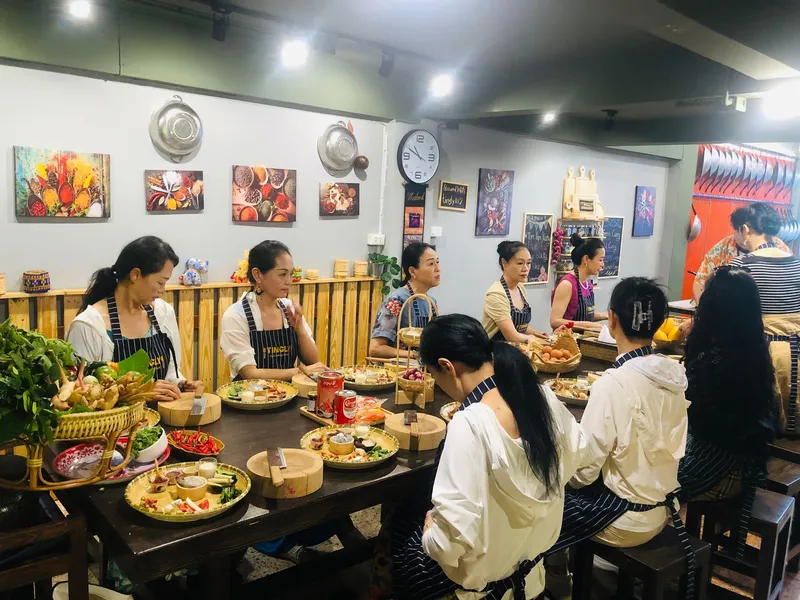
The Tingly Thai Cooking School curriculum centres on the foundational dishes of Thai home cooking — not hotel-restaurant approximations, but the actual recipes that Thai families prepare at home. Every participant cooks a minimum of five dishes across the session, working at an individual station with a full set of ingredients and tools. Nothing is demonstration-only: every dish is prepared, cooked and tasted by the participant who made it.
The specific menu varies slightly by session and season to reflect ingredient availability at the morning market, but the core dishes across most sessions include:
- Pad Thai — rice noodles, tamarind sauce, dried shrimp, egg, spring onions and bean sprouts, cooked in a hot wok over high heat
- Tom Yum soup — the classic hot and sour broth with lemongrass, kaffir lime leaves, galangal, chillies and your choice of protein
- Green curry with coconut milk — made from a paste ground fresh in a mortar and pestle, not from a jar
- Som Tum (green papaya salad) — pounded in a traditional clay mortar; you control the heat level
- Mango sticky rice — the dessert: glutinous rice steamed in coconut milk, paired with ripe Thai mango
- Additional dishes vary by session — spring rolls, massaman curry and stir-fried dishes appear regularly on the curriculum
The Tingly Thai Teaching Style
The school's approach is hands-on from the first minute. Instructors demonstrate each technique once — the correct way to pound a curry paste, the wrist motion for tossing noodles in a wok, the method for slicing lemongrass — and then participants replicate it immediately at their own station. This is not a cookery show where you watch someone else cook and receive a recipe card at the end.
Class sizes are kept small deliberately. The small-group format means the instructor can circulate and provide individual coaching: adjusting your heat level, correcting your knife grip, explaining why a particular step matters for the flavour of the finished dish. This level of personal attention is what separates the Tingly Thai experience from larger tourist cooking classes where instructors address groups of 20 or more from the front of a room.
Every participant works at a dedicated station with their own wok, mortar and pestle, chopping board and full set of pre-measured ingredients. You are cooking your own meal — not contributing to a shared pot.
- Individual stations with a full set of equipment and pre-measured ingredients
- Instructor demonstrates each technique once, then supports participants as they replicate it
- Small group size enables individual coaching — heat adjustment, knife technique, timing
- Every dish is cooked and eaten by the participant who made it
- Practical focus: the goal is dishes you can recreate at home, not just an activity to photograph
What Makes Tingly Thai Different from Other Bangkok Cooking Classes
Bangkok has dozens of cooking schools. Most fall into one of two categories: large tourist operations where participants watch rather than cook, or hotel cooking demonstrations that produce polished results through hidden preparation done in advance. Tingly Thai occupies a different position.
- Market visit at the start: the class begins at a local neighbourhood market, not a tourist market. Participants see the raw ingredients — fresh kaffir lime leaves on the branch, galangal root, green papaya — before they cook with them
- Recipes go home with you: the school provides a printed recipe pack for every dish cooked during the session. These are the actual recipes used in class, scaled for a home kitchen
- No pre-prepared elements: curry pastes are ground from whole spices during the session, not spooned from a commercial tub. Stocks are made during class
- Dietary adaptation without compromise: vegetarian, vegan and gluten-free versions of every dish are available; the instructor adjusts the recipe rather than substituting a different dish
- 1,503 independent reviews averaging 4.8 stars: the review pattern is a reliable signal — this is not a school that generates ratings through aggressive solicitation or bulk tourist groups
Ingredients and Thai Cooking Fundamentals
Part of what makes the Tingly Thai class memorable is the ingredients section at the start of the session. Before cooking begins, the instructor walks participants through the key aromatics and flavour foundations of Thai cooking — not as a lecture but as a hands-on introduction where participants smell, taste and handle each ingredient.
- Lemongrass: how to identify freshness, how to bruise versus slice, why the outer leaves are removed
- Galangal versus ginger: they look similar and are often confused; they taste completely different and are not interchangeable
- Kaffir lime leaves: the double-leaf structure, the tearing technique for releasing oils, why they're added at different stages of cooking
- Thai basil versus sweet basil: different genus, different flavour, different culinary applications
- Fish sauce and oyster sauce: the umami foundations of Thai cooking — how to balance them, how to taste for seasoning
- Palm sugar: less sweet than refined sugar, slightly caramel, the correct balancing agent for tamarind-based dishes like Pad Thai
- Coconut milk versus coconut cream: the difference in fat content and when to use each
4-Hour Half-Day Class — Full Itinerary
-
09:00
Welcome and market visit
Meet your instructor at the school. A short introduction to the session's menu and format is followed immediately by a visit to a local neighbourhood market. The instructor walks participants through the fresh ingredients for the session — lemongrass, galangal, kaffir lime leaves, fresh chillies, green papaya — and explains what to look for when selecting each one. This section takes approximately 20 minutes and gives the cooking session its context.
-
09:25
Ingredient introduction and station setup
Return to the school. Each participant takes their position at an individual cooking station. The instructor presents the full range of ingredients for the session, explaining the function of each aromatic, the difference between common substitutes (galangal versus ginger, Thai basil versus sweet basil), and the flavour principles — sour, salty, sweet, spicy — that structure Thai cooking. Pre-measured ingredients are arranged at each station.
-
09:45
First dishes: green curry paste and curry
The session's most labour-intensive component comes first, while energy is high. Participants grind a green curry paste in a traditional clay mortar and pestle — whole coriander seeds, cumin, lemongrass, galangal, green chillies, shrimp paste — until the paste reaches the correct texture. The paste is then cooked in coconut cream and finished with coconut milk, protein and kaffir lime leaves. The instructor coaches each participant on heat control, the sound of correctly tempered coconut cream, and the timing of additions.
-
10:20
Wok skills: Pad Thai and stir-fry
The wok section of the class. Participants learn the correct wok technique for Pad Thai — soaked rice noodles, tamarind paste, fish sauce, palm sugar, egg, dried shrimp, spring onions, bean sprouts — and the proper motion for tossing ingredients without losing them over the edge. The instructor demonstrates once at high heat, then participants cook their own portion. A second stir-fry dish follows, applying the same wok skills to a different flavour profile.
-
10:55
Tom Yum soup and Som Tum salad
Tom Yum — the hot and sour broth — is assembled and simmered, with participants adjusting their own seasoning balance between fish sauce, lime juice, sugar and chilli heat. Som Tum green papaya salad is prepared in the mortar: shredded green papaya pounded with tomatoes, long beans, dried shrimp, chillies, lime juice and fish sauce. Participants control their own heat level. Both dishes are tasted, adjusted and finished before the meal break.
-
11:30
Mango sticky rice and the meal
The dessert — mango sticky rice — is the final preparation: glutinous rice steamed in coconut milk and pandan leaves, served with ripe Thai mango slices and a coconut cream sauce. Once all dishes are ready, participants sit down to eat what they have cooked. This is the meal: no separate restaurant component, no shared buffet — you eat your own food. The instructor is present throughout, answering questions and providing the printed recipe pack for every dish cooked during the session.
Important Things to Know Before You Go
What to Bring
The school provides all equipment, ingredients and printed recipes. Participants do not need to bring cooking supplies. Practical clothing is recommended — a four-hour cooking session involving wok work and mortar pounding will result in splashes.
- Comfortable clothing that you don't mind getting oil or sauce splashes on — an apron is provided but won't cover everything
- Closed-toe shoes — required in the kitchen; sandals and flip-flops are not permitted at the cooking stations
- A small notebook if you want to supplement the printed recipe pack with your own observations
- Camera or phone for photographs — the market visit and the plated dishes are the main photographic moments
- Any specific dietary information: let the school know at booking, not on arrival
Not Allowed
- Open-toe footwear in the kitchen — closed-toe shoes are mandatory at all cooking stations
- Arriving significantly late — the market visit and ingredient introduction at the start are integral to the session; late arrivals miss content that cannot be replicated
- Taking ingredients from the school — all ingredients are provided for in-session use; the printed recipe pack tells you where to source everything independently
Dietary Options
The Tingly Thai Cooking School accommodates vegetarian, vegan and gluten-free participants without replacing the curriculum with alternative dishes. Every dish on the menu has a plant-based or gluten-free version that uses the same techniques and flavour structures as the standard version.
- Vegetarian and vegan: fish sauce replaced with soy sauce or mushroom-based seasoning; shrimp paste replaced with fermented soybean paste; protein choices adjusted
- Gluten-free: Thai cuisine is largely naturally gluten-free; the instructor identifies which sauces contain wheat-derived ingredients and substitutes accordingly
- Nut allergies: the standard curriculum does not use peanuts in the main dishes (they appear as a garnish on Pad Thai); notify the school at booking and they will adjust
- All dietary requirements must be communicated at time of booking — not on arrival
Who This Tour Is For
Best For
The Tingly Thai half-day cooking class is designed for travelers who want to engage with Bangkok's food culture at a practical level — not just to eat Thai food but to understand how it is made and to leave with the ability to recreate it. The class is equally rewarding for complete beginners and for participants with existing cooking experience who want to learn Thai-specific techniques.
- Food lovers who want to go beyond eating and understand how Thai dishes are actually constructed
- Couples looking for a shared activity that produces a meal at the end — consistently described in reviews as one of Bangkok's best date experiences
- Solo travelers — the small group format makes this one of the more naturally social activities in Bangkok
- Anyone who cooks at home and wants to expand their repertoire with authentic Thai recipes and technique
- Travelers on a one-trip visit to Bangkok who want a single activity that combines market experience, cultural context and a practical skill to take home
- Participants with dietary restrictions (vegetarian, vegan, gluten-free) who want a cooking class that accommodates without compromising
Not Suitable For
- Those who cannot stand for 4 hours — the cooking stations are standing workstations; there is limited seating during active cooking phases
- Children under 8 years of age — the wok work involves high heat and hot oil; the school sets a minimum age for safety reasons
- Anyone with a severe allergy to shellfish or fish products who cannot confirm in advance — fish sauce and dried shrimp are core ingredients; the instructor can substitute but cannot guarantee a completely allergen-free kitchen environment
- Participants looking for a passive demonstration class — every session requires active participation; there is no observer-only option
Bangkok Tingly Thai Cooking School — FAQs
Do I need any cooking experience to join the Tingly Thai class?
No prior cooking experience is required. The class is structured to be accessible to complete beginners while remaining genuinely instructive for experienced home cooks. The instructor demonstrates every technique before participants replicate it, and provides individual coaching throughout. The 4.8-star rating from 1,503 reviews includes a large proportion of participants who had never cooked Thai food before attending.
How many dishes do participants actually cook during the 4-hour session?
A minimum of five dishes across the four hours: typically green curry, Pad Thai, Tom Yum soup, Som Tum green papaya salad, and mango sticky rice for dessert. A sixth dish — usually a stir-fry — is included in most sessions. The specific menu varies slightly by session to reflect seasonal market availability. All five-plus dishes are cooked by each individual participant at their own station, then eaten as the closing meal.
What dietary requirements can the Tingly Thai Cooking School accommodate?
Vegetarian, vegan, and gluten-free participants are all accommodated. Fish sauce and shrimp paste — two core Thai aromatics — are substituted with plant-based equivalents for vegan and vegetarian participants without changing the dishes or the techniques used. Nut allergies (peanuts appear as a Pad Thai garnish) can be accommodated with advance notice. All dietary requirements must be communicated at booking, not on the day of the class.
Is the local market visit at the start of the class included in the price?
Yes. The market visit is part of the session and included in the $45 per person price. There is nothing to purchase at the market — all ingredients are provided by the school. The market visit is an educational component: participants see the raw ingredients in their natural market context before working with them in the kitchen. The school sources from a local neighbourhood market rather than a tourist-facing market, which means the experience reflects how Bangkok residents actually shop for produce.
How does the Tingly Thai class compare with other Bangkok cooking experiences?
The combination of individual cooking stations, a genuine market visit with fresh ingredients, and a small-group format with personal instructor coaching distinguishes Tingly Thai from larger operations where participants share stations or watch demonstrations. The printed recipe pack — included at no extra cost — means the skills learned in the session are directly transferable to a home kitchen. For a full comparison of culinary and cultural activities available in the city, see all bangkok thailand tours.
What Travelers Say About the Tingly Thai Cooking School
I've done cooking classes in Italy and Japan but the Tingly Thai session was the most practical of all of them. We actually cooked everything from scratch — grinding the curry paste in a mortar was genuinely hard work but the curry it produced tasted completely different from anything I'd made at home before. The recipes they give you at the end work. I've made the green curry twice since I got back.
The market section at the beginning set the tone for the whole class. Walking through a local Bangkok market with an instructor who explains what everything is, why it's used, and how to tell if it's fresh — that context made the cooking session make sense in a way that a classroom introduction wouldn't have. Four hours was the right length. We were tired but not bored, and the meal at the end was excellent.
Booked this for my partner and me as a half-day activity between temple visits. It turned out to be the best thing we did in Bangkok. The instructor was patient and funny, the group was small enough to feel personal, and the Pad Thai I cooked was genuinely the best Pad Thai I've eaten — which is either a compliment to the instructor's teaching or evidence that cooking your own food always tastes better. Probably both.