Bangkok White Lotus Thai Cooking Class with Market Tour — 4.9★ Review (2026)
The Bangkok White Lotus Thai Cooking Class with Market Tour is the most complete hands-on Thai cooking experience in the city: a local market walk to source ingredients, a dedicated cooking school, and the skills to cook four or more Thai dishes you will actually make at home. Rated 4.9 stars across 1,238 independent reviews — the highest rating of any Bangkok cooking class — this 5-hour session at $55 is the benchmark experience for anyone serious about Thai food. Everything you need to know is below, or browse all bangkok thailand tours to explore more experiences in the city.
About This Activity
Cancel up to 24 hours before — full refund guaranteed
Guided walk through a local Bangkok fresh market to source your ingredients
Tom yum, green curry, pad thai, and mango sticky rice — plus more by choice
Printed recipes for every dish you prepare, to recreate at home
Morning session — typical start around 08:30 or 14:00
Bangkok's highest-rated Thai cooking class
Check Live Availability & Prices
Real-time session dates and pricing — free cancellation up to 24 hours before your class.
The Market Tour — Where You Source Your Ingredients
Which Market and What You Will See
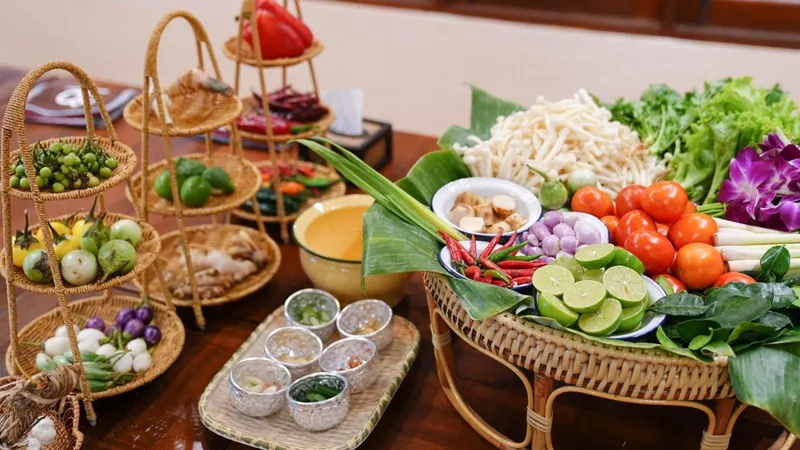
The cooking class begins not at the school but at a working Bangkok fresh market — the kind that supplies neighbourhood restaurants rather than tourists. Your guide leads the group through the market's wet section, dry goods lanes, and herb vendors, explaining the role each ingredient plays in Thai cooking before you buy anything. This is not a staged demonstration: the market is fully operational, the prices are local, and the produce reflects what Bangkok cooks are actually buying that morning.
You will walk through stalls selling fresh galangal, lemongrass, kaffir lime leaves, Thai basil, bird's eye chillies, coconut milk in various grades, and the particular shrimp pastes and fish sauces that define regional Thai cooking. The guide identifies quality markers for each — the right colour on a galangal root, how to tell fresh coconut milk from tinned, why some chillies are used for colour and others purely for heat.
- Fresh herbs and aromatics: galangal, lemongrass, kaffir lime leaf, Thai basil, coriander
- Chillies: bird's eye for heat, spur chillies for colour, dried chillies for curry pastes
- Proteins: fresh prawns, chicken thigh, tofu — selected by the guide for quality on the day
- Coconut milk: fresh-pressed versus tinned, and why it matters for curry texture
- Shrimp paste (kapi) and fish sauce: the umami foundations of Thai cooking, explained and tasted
- Tropical fruits: mangoes for dessert, papaya for salads, and produce that varies by season
What You Buy and Why the Market Matters
Each participant selects their own ingredients under the guide's instruction — not a pre-packaged kit, but actual market shopping. This has two purposes: you learn to identify quality ingredients independently, and the dishes you cook in the school taste noticeably better than classes using pre-portioned supermarket supplies.
The market visit typically takes 45 minutes and covers 300–400 metres of stalls. By the time you return to the cooking school, you understand not just what goes into Thai food but why — the flavour logic of the cuisine becomes visible when you have held and smelled the raw components before they go into the wok.
What You Will Cook — Four or More Thai Dishes
Tom Yum Soup (Tom Yum Goong)
Thailand's most internationally recognised soup is also one of the most technically instructive dishes to make. Tom yum is a clear broth built on lemongrass, galangal, kaffir lime leaves, and fish sauce, soured with lime juice and heated with chillies — with prawns as the classic protein. The White Lotus method teaches the sequence precisely: aromatics first to release oils, protein second, souring agents added off-heat to preserve brightness.
The result should be simultaneously sour, spicy, and deeply savoury — not the watery, over-sweet version common in tourist restaurants.
Green Curry (Gaeng Keow Wan)
Green curry is the class's most complex dish and the one most participants say they are most proud of cooking. You make the paste from scratch — green chillies, lemongrass, galangal, shrimp paste, and other aromatics ground together in a pestle and mortar — before cooking it in coconut milk. The school uses a two-coconut-milk technique: a small amount of thick coconut cream fried with the paste first to 'crack' it and release the oils, then thin coconut milk added to build the sauce.
This is the technique that separates restaurant-quality green curry from the flattened supermarket paste versions.
Pad Thai (Phad Thai)
The dish most visitors assume they already understand — until they cook it properly. Pad thai is a wok dish of rice noodles stir-fried with egg, bean sprouts, spring onion, and protein (typically prawns or tofu), sauced with a combination of tamarind water, fish sauce, and palm sugar. The White Lotus class teaches the correct noodle preparation (soaked, not boiled), the pan temperature required for proper wok fry, and the correct sequence of adding ingredients — all of which produce a completely different result from the stodgy pad thai often served abroad.
Finished tableside with dried chillies, lime, and crushed peanuts to the diner's own taste.
Mango Sticky Rice (Khao Niao Mamuang)
The course finishes with Thailand's defining dessert. Glutinous rice is steamed until just tender, then soaked in sweetened coconut cream seasoned with salt — the salt is not an error; it is what lifts the sweetness and makes the rice taste like itself. Served alongside slices of ripe Nam Dok Mai mango and finished with a drizzle of thick coconut cream and a scattering of toasted sesame seeds.
The class teaches the critical timing: sticky rice must be mixed with coconut cream at exactly the right temperature, while it is still warm enough to absorb properly.
Additional Dishes Available by Class Group
Depending on the session size and time, the instructor may include one or more additional Thai dishes beyond the four above. Common additions include som tum (green papaya salad, which teaches the mortar-and-pestle balance of sour-sweet-spicy-salty), massaman curry (for a slower, richer counterpoint to the green curry), or spring rolls with dipping sauce for a shareable starter. The minimum is always four complete dishes per person.
- Som tum (green papaya salad) — mortar and pestle technique, sweet-sour-spicy balance
- Massaman curry — slower method, spiced differently from green curry, coconut-based
- Fresh spring rolls — wrapping technique, dipping sauce ratios
- Stir-fried Thai basil with chilli (Pad Krapao) — the Bangkok daily staple, quick wok method
The Cooking School Setting
The White Lotus School
The White Lotus cooking school operates from a dedicated facility in central Bangkok — not a hotel kitchen or repurposed restaurant space, but a purpose-built teaching kitchen with individual gas burner stations, granite mortar-and-pestle sets, proper mise en place counters, and natural light. Each participant works at their own station throughout the class, cooking every dish themselves rather than watching a demonstration or sharing a burner with another person.
The class size is deliberately kept small — typically 8 to 12 people — so the instructor can move between stations continuously, correcting technique in real time. This is the primary reason the tour's rating has remained at 4.9 across more than 1,200 reviews: the feedback ratio between instructor and participant is unusually high for a group cooking class at this price point.
- Individual wok station per participant — no sharing, no watching only
- Granite mortar and pestle at every station for paste-making from scratch
- Maximum 8–12 participants per class for personal instructor attention
- Air-conditioned teaching kitchen — comfortable even in Bangkok's peak summer heat
- Printed recipe cards for every dish prepared, with ingredient notes and source suggestions
What You Take Home
Beyond the skills and the full stomach, every participant leaves the White Lotus class with a printed recipe booklet covering every dish prepared that day, including the ingredient quantities, sourcing notes, and the instructor's own tips for adapting recipes to ingredients available outside Thailand. The booklet is specific to the dishes cooked in your session — not a generic Thai cookbook insert. Many guests cite the recipe cards as the single most useful souvenir they bring home from Bangkok.
Full 5-Hour Class Itinerary — Bangkok White Lotus Thai Cooking Class
-
08:30
Meet your instructor at the White Lotus school
Group assembles at the cooking school. The instructor introduces the day's menu, explains the structure of the class, and gives a brief overview of Thai flavour principles — the four-pillar balance of sour, sweet, salty, and spicy that underpins every dish on the syllabus.
-
08:45
Market tour — ingredient sourcing with guide
Walk to the nearby fresh market with the instructor. Approximately 45 minutes touring wet produce, herb stalls, dried goods, and coconut milk vendors. Each participant selects their own fresh ingredients under guidance, with the instructor explaining quality markers and ingredient roles as you shop.
-
09:30
Return to school — mise en place and paste preparation
Back at the cooking school, ingredients are sorted and stations prepared. The session begins with the green curry paste — ground from scratch in granite mortars. This is the most physically active step of the class and the one that most directly demonstrates why fresh paste produces a fundamentally different result from jarred alternatives.
-
10:00
Cook dish 1 — Tom Yum Goong (prawn soup)
First cooking session at individual wok stations. The instructor demonstrates the dish in full, then each participant cooks their own portion. Aromatics are prepared, broth is built, prawns are added, and the dish is finished with lime juice and fish sauce adjusted to personal taste. You eat what you cook.
-
10:30
Cook dish 2 — Green Curry (Gaeng Keow Wan)
Using the paste made earlier, each participant cooks their own green curry using the two-stage coconut milk technique. Instructor circulates between stations to correct paste-frying temperature and sauce consistency. The class eats this dish together at the communal table — the first proper meal of the session.
-
11:00
Cook dish 3 — Pad Thai (Phad Thai)
Noodle preparation, wok technique, and the pad thai sauce ratios. The instructor focuses on heat management — the most common error in pad thai is insufficient wok temperature, which causes the noodles to steam rather than fry. Finished individually with dried chillies, lime wedge, and crushed peanuts at the table.
-
11:35
Cook dish 4 — Mango Sticky Rice (Khao Niao Mamuang)
The dessert session: glutinous rice is steamed, then mixed with salted coconut cream at the correct temperature. Mangoes are sliced. The finished dessert is plated and eaten immediately — sticky rice is at its best within minutes of being dressed. Recipe cards are distributed and the instructor reviews any questions on ingredient sourcing.
-
12:15
Optional additional dish and open Q&A
If time and appetite allow, the instructor prepares an additional dish — commonly som tum (green papaya salad) or pad krapao (Thai basil stir-fry) — as a live demonstration with group participation. Open question time on ingredients, substitutions, and adapting Thai recipes to home kitchens outside Thailand.
-
13:30
Class ends — recipe booklet collection and photos
Printed recipe booklets distributed to all participants. Group photo at the cooking school if desired. Instructor recommends Bangkok markets and specialty shops where Thai cooking ingredients can be found for those staying in the city. Class disperses from the school premises.
Important Things to Know Before You Go
What to Bring
- Comfortable clothes you do not mind getting food splashes on — cooking over a wok produces oil mist; aprons are provided but do not cover everything
- Closed-toe shoes — a cooking school with multiple gas burners and hot liquids is not the place for sandals or open shoes
- A small bag for your recipe booklet and any market purchases beyond the class ingredients
- Water bottle — the kitchen is air-conditioned but a 5-hour class involving active cooking over heat is physically warm work
- Camera or phone — the market section and the plating of finished dishes are both highly photogenic and worth documenting
Not Allowed / Not Recommended
- Arriving more than 15 minutes late — the market visit departs promptly at 08:45 and cannot be delayed for late arrivals; late participants miss the market section
- Large bags or luggage — the cooking stations are compact and there is no secure storage for wheeled suitcases or oversized backpacks; travel light for this session
- Eating a large meal beforehand — the class involves tasting every dish you cook across 5 hours; arriving hungry is strongly recommended
Vegetarian and Dietary Options
The White Lotus class accommodates vegetarian and vegan diets with advance notice at booking. Protein substitutions (tofu, mushroom, extra vegetables) are straightforward for all four core dishes, and the instructor adjusts shrimp paste use in the curry paste for vegan participants. Fish sauce is substituted with soy sauce and a small amount of seaweed-based seasoning.
Gluten-free adaptation is possible across all dishes — declare at booking. Nut allergies should be declared at booking as peanuts feature in the pad thai finish and are present in the kitchen throughout.
- Vegetarian: tofu and vegetable substitutions available for all four dishes — declare at booking
- Vegan: shrimp paste and fish sauce substitutions available — declare at booking
- Gluten-free: rice noodles and tamari substitutions available across all dishes
- Nut allergy: peanuts used in pad thai and present throughout the kitchen — declare at booking for separate preparation
Who This Tour Is For
Best For
- Home cooks who want to leave Bangkok with skills they will actually use — the recipe booklet and hands-on technique instruction make this a practical class, not a tourist performance
- Food travellers who want to understand Thai cuisine from the inside — the market visit alone is worth the price for anyone serious about food sourcing and ingredient quality
- First-time visitors to Thailand who want one concentrated experience that covers Thai flavour principles, ingredient culture, and cooking technique in a single morning
- Couples and small groups looking for an active, social half-day that produces a meal you eat together at the end
- Solo travellers — the small group format and shared cooking environment make this one of the easiest Bangkok experiences to do alone and enjoy fully
Not Suitable For
- Those with anaphylactic allergies to shellfish or peanuts — shrimp paste is used in curry paste preparation and peanuts are present throughout the kitchen at all times; the environment cannot be fully isolated even with substitutions
- Guests unable to stand for extended periods — the class involves approximately 3 hours of active standing at a cooking station and 45 minutes of walking through a market; it is not suitable for those who require seating throughout
Bangkok White Lotus Thai Cooking Class — FAQs
What dishes do you cook in the Bangkok White Lotus Thai cooking class?
The four core dishes are tom yum goong (prawn soup), green curry from scratch (gaeng keow wan), pad thai, and mango sticky rice. Depending on the session and group, the instructor may add a fifth dish — typically som tum (green papaya salad), pad krapao (Thai basil stir-fry), or fresh spring rolls. All dishes are cooked individually at your own wok station, not watched as a demonstration. Protein substitutions for vegetarian and vegan participants are available with advance notice at booking.
Is the market tour a real Bangkok market or a tourist demonstration?
It is a working Bangkok fresh market that supplies local restaurants and households — not a staged tourist experience. Prices are in Thai baht and set for local buyers. The guide accompanies the group and explains what to look for, but you are shopping in a real operating market. The market section typically takes 45 minutes and is one of the most consistently praised elements in the tour's 1,238 reviews: guests frequently cite it as more illuminating than the cooking itself.
Do I need any cooking experience for the Bangkok Thai cooking class?
No prior cooking experience is required. The White Lotus class is structured as a teaching session, not a chef's course — the instructor assumes no background knowledge and explains every technique from first principles. The class has a 4.9-star average across more than 1,200 reviews including participants who describe themselves as complete beginners in the kitchen. The mortar-and-pestle paste grinding is physically the most demanding step; the instructor assists anyone who finds it difficult.
How large are the class groups for the Bangkok White Lotus cooking class?
Groups are capped at 8 to 12 participants. This is deliberately smaller than many Bangkok cooking classes, which is the primary structural reason the tour maintains a 4.9-star rating: the instructor can move between all stations continuously and correct technique in real time rather than giving a group demonstration and hoping participants apply it correctly. Each participant cooks every dish at their own individual station — there is no pairing or sharing of burners.
Where can I find more Bangkok food and cooking experiences?
The White Lotus cooking class is the highest-rated cooking experience in Bangkok, but the city offers a full range of food-led activities — Chinatown street food tours, floating market visits, canal-side food boat tours, and multi-district food crawls. Browse all bangkok thailand tours to compare options by type, duration, and budget, and find the right food experience for your time in the city.
What Travellers Say About the Bangkok White Lotus Thai Cooking Class
Genuinely the best activity of my entire two-week Thailand trip. The market section alone was worth the price — I finally understand what lemongrass actually smells like fresh versus dried, and why it matters. Made the green curry from scratch and ate every dish I cooked. The recipe booklet has already been used three times at home.
I have done cooking classes in Vietnam, Japan, and Italy, and this is the best-organised, most skills-focused class of any of them. Small group, individual wok stations, an instructor who actually walks over and adjusts your technique rather than shouting from the front. The pad thai I made in that kitchen was better than anything I have ordered in a Thai restaurant abroad.
Came as a solo traveller and had the most enjoyable morning of my Bangkok trip. The market walk is genuinely educational — you understand Thai food completely differently once you have seen and smelled the raw ingredients. The mango sticky rice we made at the end was perfect. Already looking up where to source Nam Dok Mai mangoes in my home city.